
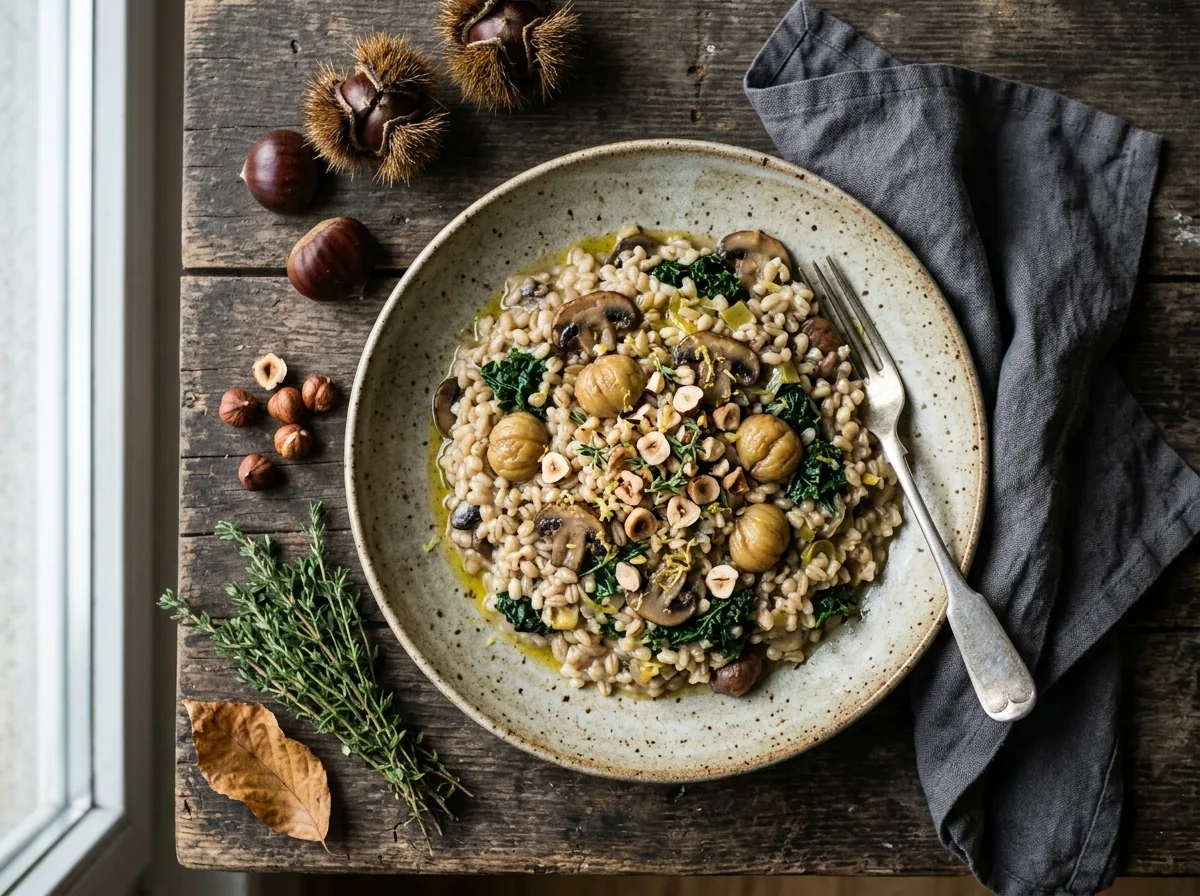
A seasonal, vegetarian autumn recipe: barley risotto is a classic from Graubünden, and pearl barley, mushrooms, chestnuts, kale, leek and hazelnuts all grow in Switzerland. The dish is fully plant-based, and plant foods usually sit far ahead of meat and cheese on their CO₂ footprint. Averaged across all ingredients Top 100 for the Environment goal.
Open the recipe straight in the Food Secrets app. The app reads the ingredients, links each one to the nutrient database and recalculates the rank for your goal.
Ingredients for 3 servings
- Pearl barley150 g
- Vegetable stock700 ml
- Mushrooms250 g
- Chestnuts, peeled and pre-cooked150 g
- Kale120 g
- Leek100 g
- Garlic1 clove
- Thyme2 sprigs
- Olive oil1 tbsp
- Hazelnuts30 g
- Lemon½
Plus pepper to taste; the stock brings the salt. Instead of button mushrooms, chanterelles or porcini from the forest work too, and savoy cabbage or spinach instead of kale. Pre-cooked chestnuts come vacuum-packed in the vegetable aisle in autumn.
Method
- Slice the leek into fine rings, chop the garlic and slice the mushrooms. Cut the kale into strips without the tough stalks.
- Heat half the olive oil in a pot and soften the leek and garlic for 3 minutes. Add the pearl barley and toast for 1 minute.
- Pour in a third of the hot stock and simmer over low heat, stirring now and then. Add the rest of the stock gradually – after 35 to 40 minutes the barley is tender but still has bite.
- Meanwhile, fry the mushrooms in the rest of the oil over high heat until golden brown. Halve the chestnuts and fry them briefly too, then add the thyme leaves.
- Cook the kale with the barley for the last 5 minutes. Toast the hazelnuts in a dry pan and chop them roughly.
- Fold the mushrooms and chestnuts into the barley risotto and season with lemon zest, a little lemon juice and pepper. Serve sprinkled with the hazelnuts.
Why this barley risotto suits the Environment goal
The Environment rank estimates a food’s CO₂ footprint from its food group; plant foods usually sit far ahead of meat and cheese, and heavy processing costs points. Every ingredient carries its band from the Food Secrets ranking – a band is stable, and the app shows you the exact figure.
- Top 10HazelnutsNuts have a small footprint – and they replace the cheese as a topping.
- Top 50ChestnutsThe autumn fruit par excellence, slightly sweet and filling.
- Top 100KaleA winter vegetable that stays in the field into the frost.
- Top 100ThymeThe herb for mushrooms and barley.
- Top 100GarlicFlavour for the base.
- Top 100MushroomsMushrooms grow without farmland and bring umami to the dish.
- Top 250Pearl barleyA grain that grows in Switzerland – the base of the barley risotto.
- Top 250LeekMild sweetness for the base.
- Top 250Vegetable stockThe liquid that makes the barley creamy.
Averaged across all ingredients, the barley risotto lands in the Top 100. Olive oil and lemon carry no band: for this goal they sit in the lower half of the ranking – a tablespoon of oil and a little lemon round off the dish.
Season and region are not counted by the rank: transport makes up only a small share of a food’s emissions. That the ingredients are in season in Switzerland now makes the dish fresher and cheaper – the footprint is set mainly by the dish being plant-based.
Variations
- With cheese: stir in 30 g of grated Sbrinz at the end. That makes it creamier, but costs points for the Environment goal.
- With pumpkin: soften 200 g of diced pumpkin with the leek.
- With wild mushrooms: replace part of the button mushrooms with chanterelles or porcini.
- Using up leftovers: shape leftover barley risotto into small patties the next day and fry them until crisp.
More on seasonal and regional eating
Which foods have a small footprint and what is in season right now is shown on the page Seasonal and regional nutrition. Another plant-based dish built on pulses is the Lentil and sauerkraut bowl with apple and mustard.
Ingredients onto the shopping list, recipe into the week plan – in one step.
Frequently asked questions about this recipe
What is a barley risotto?
A risotto made with pearl barley instead of rice, as it is cooked in Graubünden. The barley takes a little longer than rice, but keeps its bite and turns creamy as you stir. More dishes for every goal are in the healthy recipes by goal.
Which recipes are in season in autumn?
Dishes with mushrooms, chestnuts, pumpkin, cabbage, leeks, apples and nuts. What is in season in which month is shown on the page Seasonal and regional nutrition, and in the app you filter the food table by season.
Is regional always better for the climate?
Not automatically. For the CO₂ footprint, what matters most is what is on the plate: plant foods usually sit far ahead of meat and cheese, and transport makes up only a small share. That is why the Environment rank works from the food group – you see it for every food in the Food Rankings.
Which foods lead for the Environment goal?
At the top are wild plants such as nettle, dandelion and wild garlic, together with nuts such as hazelnut and walnut, forest mushrooms, chestnuts and berries. The full list is in the Food Rankings.
What does “Top 100” mean at Food Secrets?
The app rates more than 1000 foods and gives each a rank per goal. “Top 100” means: averaged across all ingredients, this recipe sits among the best hundred for the goal Environment. We print bands rather than place numbers, because the database keeps growing. The app works out the current value after the import.
More healthy recipes and food rankings
- All healthy recipes by goal – seasonal recipes and recipes for weight loss, blood pressure, digestion and other health goals.
- Green shakshuka with spinach and kale – the weight loss recipe.
- Chili sin carne with cocoa and beans – the recipe for blood pressure.
- Seasonal and regional nutrition – the Environment goal in the app – every food by its footprint.
- Recipe generator: import and analyse healthy recipes – read any recipe from the web, calculate nutrients and create the shopping list automatically.
The bands on this page are a snapshot of the Food Secrets ranking. The database keeps growing, which is why we name ranges rather than place numbers – the app works out the current value at any time. The information provided is for general education and does not replace medical advice or treatment.