


formerly: dementia
Your brain is about 60 per cent fat, and DHA — an omega-3 fatty acid — is the building block of its nerve membranes. People who ate along the MIND pattern for years (berries, leafy greens, nuts, fish, olive oil) showed a markedly slower decline in thinking ability in a long-term study.
The brain & cognition rank scores what a food brings for that: omega-3 with DHA, anthocyanins from berries, vitamin E, folate, B6 and B12 for nerve function, plus anti-inflammatory compounds and a good microbiome.
This is about supply over years, not about treating a disease. Diet is one factor among several, alongside sleep, movement and mental activity.
Points come from DHA and EPA in oily fish, anthocyanins from berries, vitamin E from nuts, folate from leafy greens and the B vitamins, plus anti-inflammatory compounds. Points are lost to sugar, saturated fat, alcohol and heavy processing.
The MIND pattern in one sentence: leafy greens most days, berries or nuts most days, oily fish once or twice a week, olive oil as the default fat.
More on the blog: Diet for dementia patients: what helps – what the MIND studies show and what helps carers with eating and drinking.
Frequently asked questions
Which foods are good for the brain?
Oily fish for DHA — sardine, mackerel, herring, salmon, trout. Then blueberries for anthocyanins, walnuts for vitamin E, leafy greens for folate and lutein, and olive oil as the default fat. Together that is the MIND pattern.
Without fish: flaxseed, walnuts and hemp seeds supply ALA; algae oil supplies DHA directly.
The Food Secrets app holds all 1000+ foods sorted by this goal, with omega-3 from fish and from plants counted in the rank. all 1000+ foods sorted by this goal
Which foods are bad for the brain?
Mainly anything that swings blood sugar hard and drives chronic inflammation: sugar and white flour, heavily processed products, plenty of saturated fat, and alcohol. Those are exactly what costs points in our ranking.
The underrated one is the fatty-acid ratio. Sunflower and safflower oil carry a great deal of omega-6, and an excess of it works against what omega-3 does.
The app shows you all 1000+ foods sorted by this goal. all 1000+ foods sorted by this goal
What are the best foods for brain health?
Among the leaders of our ranking are the oily fish — sardine, mackerel, herring and salmon — for their DHA. Just as far forward are walnuts and chia seeds with plant omega-3, and black elderberry with its anthocyanins; blueberry follows in the Top 50. Leafy greens and olive oil from the MIND pattern complete the picture.
Dried herbs such as marjoram and oregano are not at the top of the ranking, because they count only with the small amount you actually eat: they add to these foods but do not replace them.
If you do not eat fish: flaxseed, walnuts and hemp seeds supply ALA, of which the body converts only a small share into DHA. Algae oil is the direct plant source of DHA.
Can diet help prevent dementia?
Diet is one of several modifiable factors, and in observational and long-term studies the MIND pattern shows the clearest association with a slower decline in thinking ability.
What does not follow from that is a guarantee. No food prevents dementia and this page promises none. It shows which foods supply the brain best — diet acts here alongside sleep, movement, blood pressure and mental activity.
How much omega-3 do I need?
One to two servings of oily fish a week is the usual orientation. More important than the amount is the ratio: a western diet carries a great deal of omega-6 from sunflower and safflower oil, and omega-3 works against that imbalance.
So the rank counts omega-3 content: omega-3 from fish (EPA and DHA) in full, plant ALA only in small part, because the body converts little of it.
What improves concentration in the short term?
In the short term what helps most is anything that keeps blood sugar steady: a meal with protein, fat and fibre rather than fast carbohydrate alone. The dip after a sugary snack is what actually costs you concentration.
The rank on this page scores the long line instead — supply over years, not this afternoon.
Studies
- [1] Morris MC, Tangney CC, Wang Y, et al. MIND diet slows cognitive decline with aging. Alzheimers Dement 2015;11(9):1015–1022. https://doi.org/10.1016/j.jalz.2015.04.011
- [2] Devore EE, Kang JH, Breteler MM, Grodstein F. Dietary intakes of berries and flavonoids in relation to cognitive decline. Ann Neurol 2012;72(1):135–143. https://doi.org/10.1002/ana.23594
Food Secrets

Reach all your goals!
With our nutrition app you have everything about nutrition in one app, always at hand.
Recipe for this goal
Scored recipes: every ingredient carries its rank out of 1000+ rated foods, and the plate takes its band from them.
Recipe · Brain & Cognition
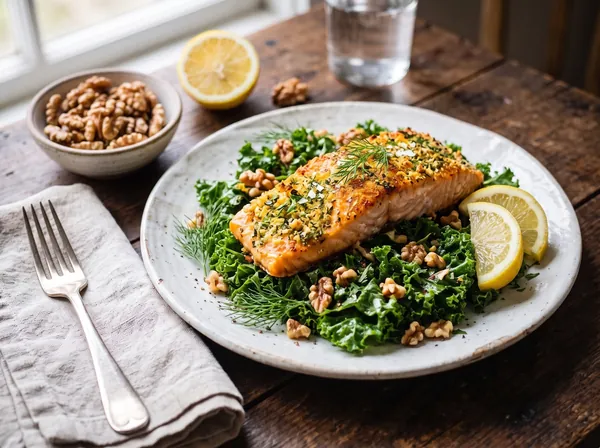
Baked Salmon on Kale Salad with Walnuts, Lemon and Dill
Baked salmon on massaged kale with toasted walnuts, lemon and dill – oily fish, leafy greens and nuts from the MIND pattern on one plate. Ready in 25 minutes – and for the goal Brain & Cognition it lands in the Top 100 of 1000+ rated foods.
25 minutes — 2 servings — Top 100 · Brain & Cognition