
Diet for dementia patients — what the research shows and what helps every day
If you care for someone with dementia, you ask yourself two things: what should they eat today? And would a different diet have changed anything? This article answers both honestly — with the studies that exist.
Three sentences first
- No food prevents dementia. Anyone who promises that is promising too much.
- One eating pattern is linked with slower mental decline: plenty of leafy greens, berries, nuts, fish and olive oil. Proof from a large intervention trial is still missing.
- Once dementia is there, what matters most is eating and drinking enough. Malnutrition and too little fluid are more common problems than the wrong foods.
Can diet prevent Alzheimer's disease?
The best-known lead is the MIND pattern, a blend of Mediterranean cooking and the blood-pressure-lowering DASH diet. In a long-term observation of 960 older people in Chicago, those who ate most closely to it declined mentally much more slowly over about five years — the difference was equal to about 7.5 years of age. In the same cohort, this group also had about half as many new Alzheimer's diagnoses. A pooled analysis of eleven cohorts with more than 220,000 people found the same link, if weaker: about one sixth fewer cases of dementia among those who ate most closely to MIND.
That is an association, not proof. People who eat this way often live more healthily in other ways too. That is why the pattern was tested in a randomised trial in 2023: 604 people with a family history of dementia followed either the MIND diet or a comparison diet for three years, both with slightly reduced calories. Thinking skills improved in both groups — there was no difference between them.
A Spanish study came out differently: 334 older people at high cardiovascular risk ate Mediterranean food with extra olive oil or nuts for about four years. Their thinking skills held up better than in the comparison group on a low-fat diet, whose scores declined.
The picture is a little better when diet does not stand alone. In the Finnish FINGER study, 1,260 people at higher risk received two years of dietary advice, exercise, memory training and checks of blood pressure and blood sugar. Their thinking skills developed measurably slightly better than in the comparison group.
The Lancet Commission on dementia names 14 modifiable risk factors, including high blood pressure, diabetes, high LDL cholesterol, obesity and heavy drinking. Diet acts on several of them — and that is the most honest reason to take it seriously.
Blood pressure is the best-proven lever. In twelve randomised trials with more than 92,000 people, lowering blood pressure with medication slightly but measurably reduced the risk of dementia or cognitive impairment. Less salt and a DASH-style diet lower blood pressure — a proven effect, and a concrete way diet can help.
What goes on the plate
The pattern is not a diet plan but a direction. What counts is what is eaten on most days, not the single meal.
Leafy greens
Kale, spinach, salad leaves. They provide folate, vitamin K and lutein.
Berries
Blueberries above all. In a study of more than 16,000 older women, eating more berries went along with mental ageing delayed by up to two and a half years.
Oily fish
Sardine, mackerel, herring, salmon. They bring DHA, an omega-3 fatty acid that is a building block of nerve cells.
Nuts, pulses, olive oil
A handful of walnuts, lentils or beans several times a week, olive oil as the everyday fat, and wholegrain instead of white flour.
Less of these: sweets and pastries, fried food, butter and margarine in large amounts, fatty cheese, red and processed meat. These are the groups that cost points in the MIND pattern. Ultra-processed foods stand out too: in ten observational studies with more than 860,000 people, those who ate the most of them had about a 44 per cent higher risk of dementia — again an association, not proof.
What should a dementia patient eat?
As dementia progresses, the question shifts. It is less about the ideal food and more about whether enough is eaten at all. Many people with dementia lose weight: they forget to eat, no longer recognise food as food, find cutlery harder to handle or taste things differently than before.
The European guideline of the ESPEN society therefore recommends checking weight and fluid intake regularly, helping at meals, offering suitable cutlery and tableware and looking after oral health. What often helps day to day:
- Fixed times and a calm table. Few distractions, no television on, plenty of time.
- Eat together. Someone who sees another person eating often joins in.
- One thing at a time. A full plate with many components overwhelms faster than one course after another.
- Finger food. Vegetable sticks, small pieces of omelette, oven-baked fish fingers or bread cubes can be eaten without cutlery and preserve independence.
- Favourite dishes and strong flavours. The sense of taste fades; familiar dishes and a little more seasoning are more likely to be eaten.
- Small portions, more often. Several small meals and snacks are easier than three large ones.
- A soft texture when chewing or swallowing becomes hard. Frequent choking needs to be assessed by a doctor or a speech and language therapist.
Oral nutritional supplements from the pharmacy can help when someone is clearly losing weight. They improve nutritional status — they do not improve memory, and the guideline does not recommend them for that.
Drinking enough — the underestimated problem
With age, thirst comes later, and with dementia drinking is also forgotten. Too little fluid can make a person more confused and tired and make falls more likely. Even mild fluid loss measurably worsens attention and thinking, and more clearly from a water loss of about two per cent of body weight. It can make dementia look worse than it is.
- Put drinks within sight and reach and use easy-to-grip cups instead of heavy glasses.
- At every meal and in between, offer drinks actively— do not wait to be asked.
- Even soups, water-rich fruit and yoghurt count.
- How much someone should drink depends on their heart and kidneys. That belongs in the conversation with the doctor.
Which foods nourish the brain best
In the Food Secrets app, the Brain & Cognition ranking scores over 1000 foods by what they bring for nerves and thinking: omega-3 with DHA, anthocyanins from berries, vitamin E, folate and the B vitamins, plus anti-inflammatory compounds, a healthy microbiome and – as in the MIND pattern – blood pressure. Sugar, saturated fat, alcohol and heavy processing cost points.
- Top 10: black elderberry, walnuts, sardines and chia seeds.
- Top 20: mackerel, herring, salmon, blueberries and linseed.
- Top 50: kale, broccoli and blackberries.
- Top 100: spinach and raspberries.
Two things stand out. Rapeseed oil ranks just ahead of olive oil, because it brings plant omega-3. Olive oil is still a good everyday fat. And pulses sit in the middle — they belong to the MIND pattern for their fibre and protein, not for any special nutrients for the brain.
You will find the full ranking with all values on the Brain & Cognition page and in the Food Rankings.
The MIND pattern on one plate
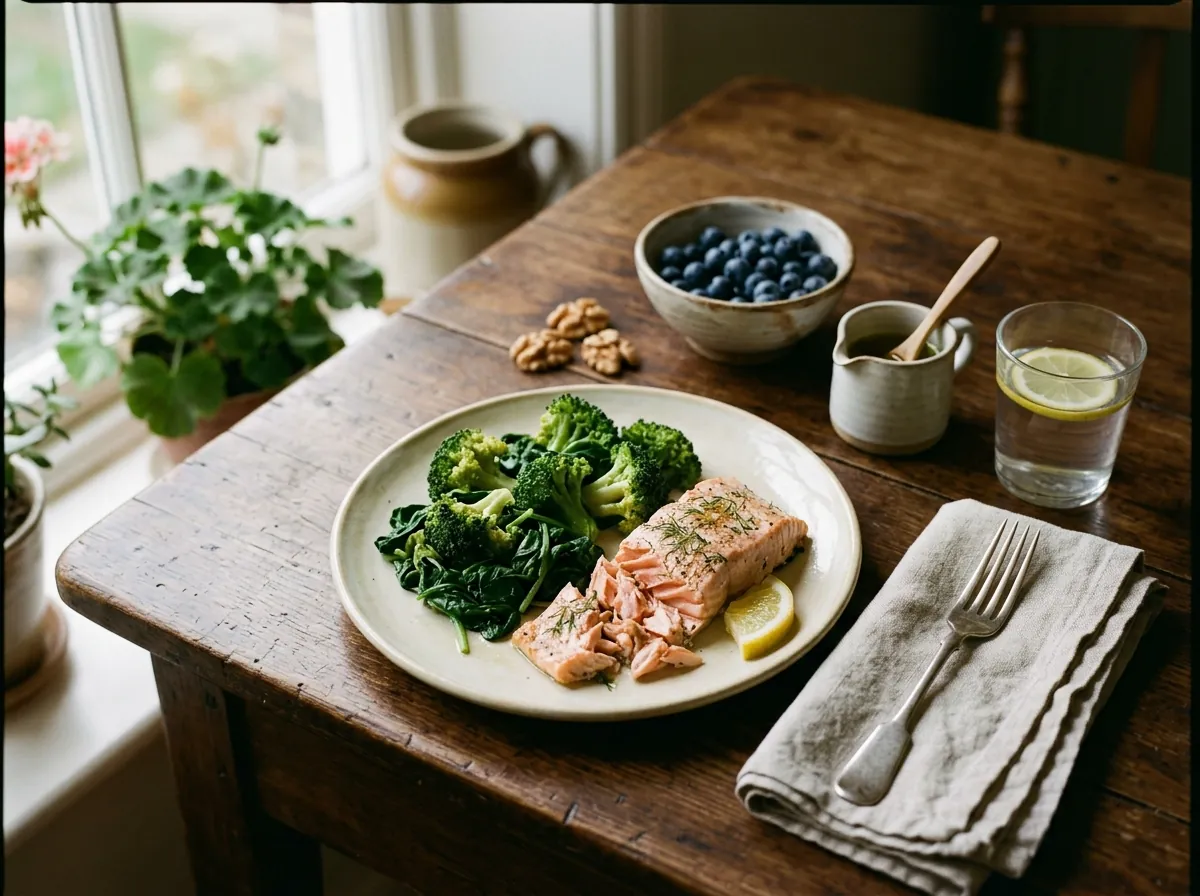
Oily fish, leafy greens and nuts: the Baked salmon with kale, walnuts and dill combines three groups of the MIND pattern in one dish. Ready in 25 minutes, in the Top 100 for the goal Brain & Cognition.
Turning knowledge into a weekly plan
For carers, knowledge is not the hard part. The hard part is putting something on the table every day that actually gets eaten.
Frequently asked questions — diet and dementia
What diet is best for dementia?
There is no dementia diet that stops the disease. The best studied is the MIND pattern with leafy greens, berries, nuts, fish, pulses and olive oil. Once dementia is present, the most important thing is eating and drinking enough — familiar dishes, small portions and help at the table. In the Food Secrets app you will find all foods sorted by the Brain & Cognition goal.
Can diet prevent Alzheimer's disease?
There is no guarantee. In observational studies, the MIND pattern is linked with slower mental decline and fewer Alzheimer's diagnoses. But a three-year randomised trial in 2023 found no advantage over a comparison diet. Diet works more through blood pressure, blood sugar and weight — and those are proven risk factors. The Brain & Cognition ranking shows which foods contribute most.
What should an elderly person with dementia eat when they hardly eat any more?
Favourite dishes, small portions spread over the day, finger food and strong flavours often help. Eating together and allowing plenty of time matter more than the perfect composition. Clear weight loss needs to be checked by a doctor; oral nutritional supplements can improve nutritional status. With the Food Secrets app you can import familiar recipes and plan them for the week.
Do omega-3 capsules help with Alzheimer's?
Not on current evidence. The European ESPEN guideline explicitly does not recommend routine omega-3 capsules in dementia, nor a ketogenic diet. In observational studies, more omega-3 from food, especially DHA, went along with about 20 per cent less dementia or cognitive decline. Oily fish once or twice a week is still worthwhile, because it provides more than a single fatty acid. Which fish provide the most DHA is shown in the Food Secrets app.
How much should a person with dementia drink?
That depends on body weight, heart and kidneys and should be discussed with the doctor. More important than a number is putting drinks where they can be seen and offering them regularly, because the feeling of thirst fades with age. Soups, water-rich fruit and yoghurt count too. You will find water-rich foods in the Food Lab of the Food Secrets app.
Which foods are bad for the brain?
In the MIND pattern, sweets and pastries, fried food, a lot of butter, fatty cheese and red and processed meat cost points. Heavy drinking is also a recognised risk factor for dementia. A general ban is not necessary; what matters is what is on the plate on most days. How each food scores for the brain is shown in the Brain & Cognition ranking.
Studies
- Morris MC, Tangney CC, Wang Y, et al. MIND diet slows cognitive decline with aging. Alzheimers Dement 2015;11(9):1015–1022. doi:10.1016/j.jalz.2015.04.011
- Morris MC, Tangney CC, Wang Y, et al. MIND diet associated with reduced incidence of Alzheimer's disease. Alzheimers Dement 2015;11(9):1007–1014. doi:10.1016/j.jalz.2014.11.009
- Chen H, Dhana K, Huang Y, et al. Association of the MIND Diet With the Risk of Dementia. JAMA Psychiatry 2023;80(6):630–638. doi:10.1001/jamapsychiatry.2023.0800
- Barnes LL, Dhana K, Liu X, et al. Trial of the MIND Diet for Prevention of Cognitive Decline in Older Persons. N Engl J Med 2023;389(7):602–611. doi:10.1056/NEJMoa2302368
- Valls-Pedret C, Sala-Vila A, Serra-Mir M, et al. Mediterranean Diet and Age-Related Cognitive Decline: A Randomized Clinical Trial. JAMA Intern Med 2015;175(7):1094–1103. doi:10.1001/jamainternmed.2015.1668
- Ngandu T, Lehtisalo J, Solomon A, et al. A 2 year multidomain intervention of diet, exercise, cognitive training, and vascular risk monitoring versus control to prevent cognitive decline in at-risk elderly people (FINGER). Lancet 2015;385:2255–2263. doi:10.1016/S0140-6736(15)60461-5
- Hughes D, Judge C, Murphy R, et al. Association of Blood Pressure Lowering With Incident Dementia or Cognitive Impairment: A Systematic Review and Meta-analysis. JAMA 2020;323(19):1934–1944. doi:10.1001/jama.2020.4249
- Sacks FM, Svetkey LP, Vollmer WM, et al. Effects on blood pressure of reduced dietary sodium and the Dietary Approaches to Stop Hypertension (DASH) diet. N Engl J Med 2001;344(1):3–10. doi:10.1056/NEJM200101043440101
- Devore EE, Kang JH, Breteler MM, Grodstein F. Dietary intakes of berries and flavonoids in relation to cognitive decline. Ann Neurol 2012;72(1):135–143. doi:10.1002/ana.23594
- Wei BZ, Li L, Dong CW, et al. The Relationship of Omega-3 Fatty Acids with Dementia and Cognitive Decline: Evidence from Prospective Cohort Studies of Supplementation, Dietary Intake, and Blood Markers. Am J Clin Nutr 2023;117(6):1096–1109. doi:10.1016/j.ajcnut.2023.04.001
- Henney AE, Gillespie CS, Alam U, et al. High intake of ultra-processed food is associated with dementia in adults: a systematic review and meta-analysis of observational studies. J Neurol 2024;271(1):198–210. doi:10.1007/s00415-023-12033-1
- Wittbrodt MT, Millard-Stafford M. Dehydration Impairs Cognitive Performance: A Meta-analysis. Med Sci Sports Exerc 2018;50(11):2360–2368. doi:10.1249/MSS.0000000000001682
- Volkert D, Beck AM, Faxén-Irving G, et al. ESPEN guideline on nutrition and hydration in dementia – Update 2024. Clin Nutr 2024. doi:10.1016/j.clnu.2024.04.039
- Livingston G, Huntley J, Liu KY, et al. Dementia prevention, intervention, and care: 2024 report of the Lancet standing Commission. Lancet 2024. doi:10.1016/S0140-6736(24)01296-0
The rank figures come from the Food Secrets catalogue (over 1000 foods, Brain & Cognition ranking) and are given as ranges, not as exact positions.
- Brain & Cognition — the nutrition goal in the app – all foods by what they contribute to nerves and thinking.
- Longevity nutrition — meaning, healthspan & longevity – what healthy ageing has to do with food.
- Food Rankings – over 1000 foods across 15+ health goals.
- Baked salmon with kale, walnuts and dill – the recipe for the MIND pattern, ready in 25 minutes.
Start for free now
Import familiar recipes, plan them for the week and put the ingredients on the shopping list with one tap. The foods for brain and nerves are sorted right beside them.


Note: this information does not replace medical advice. Always discuss diet, weight loss and fluid intake in dementia with the treating doctor.