
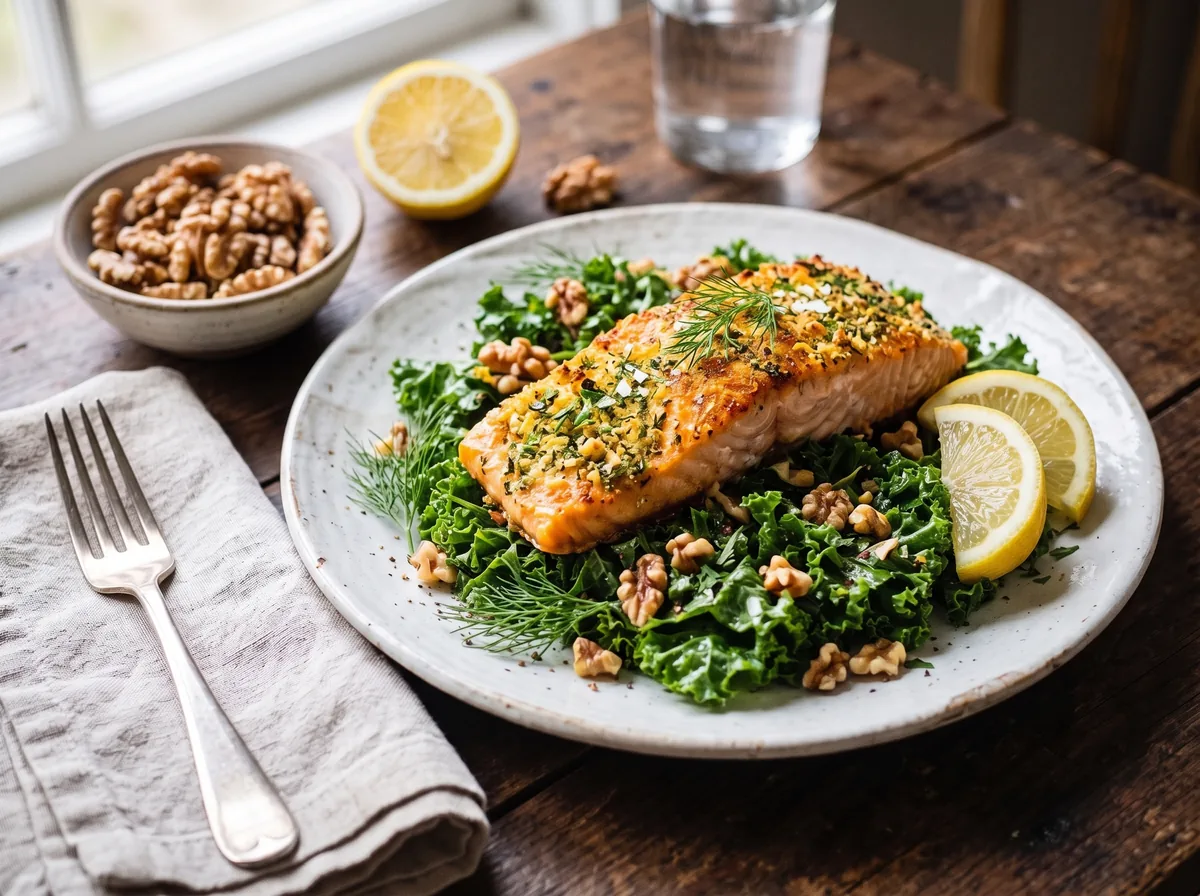
A recipe for brain and cognition, which puts three MIND food groups on one plate: oily fish, leafy greens and nuts. Lemon and dill keep the salmon fresh. Seven of the nine ingredients are in the Top 100 of the ranking, overall Top 100.
Open the recipe straight in the Food Secrets app. The app reads the ingredients, links each one to the nutrient database and recalculates the rank for your goal.
Ingredients for 2 servings
- Salmon fillet250 g
- Kale150 g
- Walnuts30 g
- Rapeseed oil1 tbsp
- Linseed, ground10 g
- Parsley10 g
- Mustard seeds, ground½ tsp
- Lemon juice20 ml
- Dill5 g
Plus salt and pepper to taste. They are not in the ingredient list, so the rank above matches what the app calculates after the import.
Method
- Preheat the oven to 200 °C (top and bottom heat). Pat the salmon dry, season with salt and pepper and sprinkle with half of the finely chopped parsley.
- Place the salmon on a baking tray lined with baking paper and bake for 12 to 15 minutes, until the centre is just no longer glassy.
- Meanwhile, strip the kale leaves from the tough stalks and chop them finely. Knead with the rapeseed oil, mustard powder, half of the lemon juice and a pinch of salt for 2 minutes, until the kale softens.
- Roughly chop the walnuts and toast them in a dry pan for 2 to 3 minutes.
- Mix the walnuts, ground linseed, the rest of the parsley and the picked dill into the kale.
- Divide the salad between two plates, place the salmon on top and drizzle with the rest of the lemon juice.
Why this plate feeds the brain well
Every ingredient carries its band from the Food Secrets Brain & Cognition ranking. A band is stable – a place number changes with every data release, and the app shows you the exact figure.
- Top 10WalnutsPlant omega-3 and vitamin E. Toasted, they go especially well with salmon.
- Top 20SalmonOmega-3 with DHA, a building block of nerve cells, plus vitamin B12.
- Top 20LinseedMore plant omega-3, better available when ground.
- Top 50ParsleyApigenin, a flavonoid that counts in the rank – very concentrated in a small amount.
- Top 50KaleA leafy green with folate. The MIND pattern has it on most days.
- Top 100Mustard seedsMustard powder binds oil, lemon and kale into a dressing.
- Top 100DillThe classic partner of salmon and lemon.
- Top 250Rapeseed oilPlant omega-3 – which is why it ranks ahead of olive oil for this goal.
Averaged across all ingredients, the plate lands in the Top 100, and of all the goals in the app, Brain & Cognition is the one where it scores best. The lemon juice carries no band: for this goal it sits in the lower half of the ranking – it is here because it makes the kale soft and fresh.
Variations
- Other fish: mackerel or herring instead of salmon. For this goal, both are also in the Top 20.
- Without fish: 200 g fried tofu and double the linseed. The DHA from fish is then missing; algae oil supplies it directly.
- As a full meal: mix 200 g warm lentils into the kale.
- And the berries? Blueberries belong to the MIND pattern, but they hardly suit fish. Have them for breakfast or dessert instead.
More about diet and the brain
What the MIND studies show and what helps carers in daily life is explained in the article Diet for dementia and Alzheimer's. All foods for this goal are on the page Brain & Cognition.
Ingredients onto the shopping list, recipe into the week plan – in one step.
Frequently asked questions about this recipe
How often should you eat fish for the brain?
In the MIND pattern, fish counts from one meal a week. Oily fish such as salmon, mackerel or herring once or twice a week is a good direction. There is, however, no proof from a large intervention trial – more on this in the article Diet for dementia and Alzheimer's.
Why rapeseed oil instead of olive oil?
Rapeseed oil brings plant omega-3, so in the Brain & Cognition ranking it sits just ahead of olive oil; both are in the Top 250. Its mild taste suits this salad, but olive oil works just as well. You will find both on the Brain & Cognition.
Can I prepare the salad ahead?
Yes. Once massaged, kale keeps in the fridge until the next day and even gets more tender. Add the nuts and dill just before eating so they stay crunchy and fresh. With one tap, the Food Secrets app puts every ingredient on your shopping list.
Which foods are good for the brain?
In the Food Secrets ranking Brain & Cognition, black elderberry, walnuts, sardines and chia seeds come first, together with hemp seeds, aronia and herbs such as marjoram and oregano. Close behind are mackerel, blueberries, herring, salmon and linseed. The full list is in the Food Rankings.
What does “Top 100” mean at Food Secrets?
The app rates more than 1000 foods and gives each a rank per goal. “Top 100” means: averaged across all ingredients, this recipe sits among the best hundred for the goal Brain & Cognition. We print bands rather than place numbers, because the database keeps growing. The app works out the current value after the import.
More healthy recipes and food rankings
- All healthy recipes by goal – recipes for the brain, digestion, blood sugar, heart, immune system and other health goals.
- Lentil and sauerkraut bowl with apple and mustard – the recipe for digestion and the liver.
- Brain & Cognition — the nutrition goal in the app – all foods by what they do for nerves and thinking.
- Recipe generator: import and analyse healthy recipes – read any recipe from the web, calculate nutrients and create the shopping list automatically.
The bands on this page are a snapshot of the Food Secrets ranking. The database keeps growing, which is why we name ranges rather than place numbers – the app works out the current value at any time. The information provided is for general education and does not replace medical advice or treatment.