
Polyphenol and flavonoid foods — which phytonutrients are where, and what they do
Berries, cabbage, herbs, tea and cocoa are known as antioxidant foods. Behind them are thousands of plant compounds, also called phytonutrients. This article sorts the most important ones, names the foods that carry them and shows what they count towards in the Food Secrets app.
Three things first
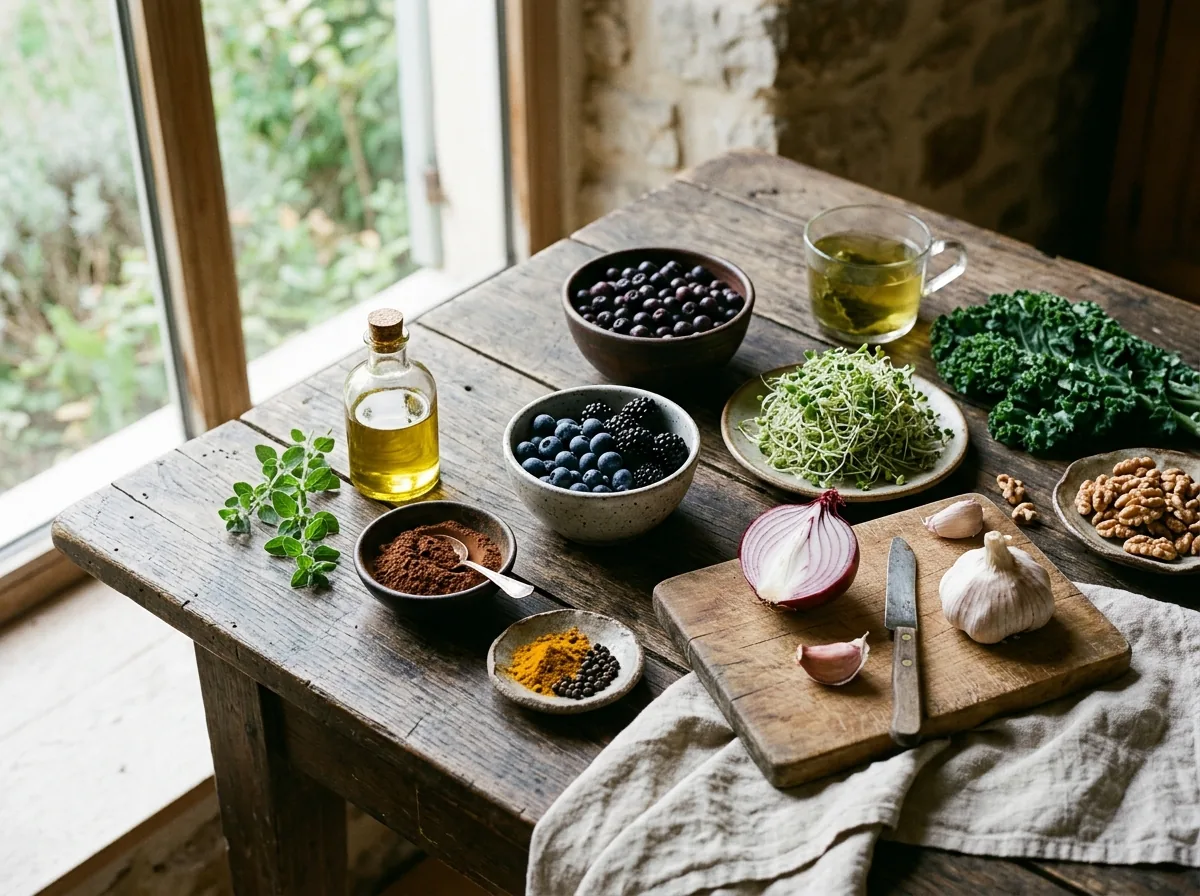
- Spices and herbs carry the most antioxidants per 100 grams, followed by berries, cocoa, nuts and dark leafy greens. In daily life, though, what counts is the amount you actually eat: berries, cabbage, onions, tea and coffee.
- A plant compound is not a goal. Nobody wants “more quercetin”; people want a body that works well. That is why this article shows, for every compound, which nutrition goal it counts towards in the app.
- Variety beats superfoods. Every plant family brings different compounds. Five different colours on the plate cover more than the biggest portion of a single food.
What are phytonutrients — and are phytonutrients antioxidants?
Plants make phytonutrients (secondary plant compounds) to protect themselves from sun, pests and disease, and to get their colour, scent and taste. “Secondary” only means that the plant does not need them to grow, unlike protein, fat or carbohydrates. Tens of thousands of these compounds are known; a few thousand occur in our food.
The largest groups are:
- Polyphenols — the largest family. It includes the flavonoids (for example quercetin, anthocyanins, catechins from tea and cocoa), phenolic acids (caffeic acid, gallic acid, ellagic acid), lignans from seeds, and resveratrol.
- Carotenoids — the yellow, orange and red pigments, such as lycopene from tomatoes.
- Sulphur compounds — glucosinolates from cabbage (sulforaphane forms from them) and alliin from garlic and onions.
- Others, such as curcumin from turmeric or the secoiridoids from olives.
Antioxidant is not the name of a compound but a property: in a test tube, the substance neutralises free radicals. Many phytonutrients can do this, and so can vitamin C and vitamin E. In the body, many plant compounds probably act less as direct radical scavengers and more as a signal: they switch on the body’s own protective systems. Sulforaphane from broccoli is the best-studied example.
Which foods are highest in antioxidants and polyphenols?
Two large sets of measurements give the answer. A Norwegian group measured the antioxidant content of more than 3100 foods: spices and herbs led by a wide margin, followed by berries, fruit, nuts, chocolate and vegetables. The French Phenol-Explorer database counts the individual polyphenols and used them to identify the 100 foods that contain the most:
- Spices and dried herbs lead, above all cloves at around 15,000 milligrams per 100 grams, along with dried peppermint, star anise, oregano and celery seed.
- Cocoa: cocoa powder and dark chocolate.
- Dark berries such as aronia, black elderberry, blackcurrants and blueberries.
- Seeds and nuts: flaxseed, chestnuts and hazelnuts.
- Vegetables: above all olives and artichokes.
Per serving, the list looks different. Nobody eats 100 grams of cloves. With usual amounts, the foods that move up are the ones eaten often and in larger quantities: berries, coffee, tea, apples, artichokes and nuts.
Whether a high intake goes with a longer life was studied in a Danish cohort of more than 56,000 people. Over 23 years, people who ate more flavonoids had a lower risk of death. The association grew stronger up to about 500 milligrams a day and then levelled off — roughly a cup of tea, an apple, an orange, 100 grams of blueberries and 100 grams of broccoli. This is an association from an observational study, not proof of cause and effect.
Which phytonutrients are there, and which foods carry them?
The Food Secrets catalogue records 20 plant compounds for more than 1000 foods. For five of them, good measurement data confirm our values. For those we name the food that leads. For the others we name the food groups in which they occur.
Kaempferol, myricetin, phenolic acids, thymoquinone
Kaempferol is found in watercress, rocket, kale and capers, myricetin in parsley and goji berries. Caffeic acid comes mostly from coffee, gallic acid from chestnuts, cloves and strawberries. Thymoquinone occurs almost only in black seed oil; it counts towards Allergy and Antimicrobial. In the Food Lab you can sort by each of these compounds as its own column.
How much sulforaphane is in broccoli and broccoli sprouts?
Broccoli does not contain finished sulforaphane. The plant stores a precursor, glucoraphanin, and an enzyme, myrosinase. Only when you cut or chew it do the two meet, and sulforaphane forms.
- Sprouts have many times more. In the first measurements, three-day-old broccoli sprouts contained 10 to 100 times more glucoraphanin than mature broccoli.
- Raw or briefly cooked is better. In one study the body absorbed around 37 per cent of the sulforaphane from raw broccoli, but only around 3 per cent from well-cooked broccoli. Long cooking destroys the myrosinase.
- Chop and wait a moment. Chopping broccoli and letting it rest for a few minutes before steaming gives the enzyme time.
In the app, the Digestion & Liver rank has broccoli sprouts in the top 10. What sulforaphane measurably does for the liver is covered in the article Liver detox foods: what really helps.
How more ends up on your plate
- Tomatoes with oil and heat. In one study, blood lycopene after tomato paste was two and a half to almost four times higher than after fresh tomatoes, both eaten with a little oil. Lycopene is fat-soluble, so a splash of olive oil belongs with it.
- Turmeric with pepper. With piperine from black pepper, curcumin absorption in humans rose many times over — in one study by around 2000 per cent.
- Chop garlic and let it rest. As with broccoli, the active compound only forms through an enzyme once the cells are damaged.
- Olive oil with a bite. Olive oil polyphenols contribute to the protection of blood lipids from oxidative stress — one of the few authorised EU health claims on plant compounds. It applies to oils with at least 5 mg of hydroxytyrosol and related compounds per 20 grams. A fresh, slightly bitter oil that catches in the throat usually has more of them.
- Eat the skin and the colour. Many plant compounds sit in the skin and the outer leaves: apple peel, the red layers of onions, dark cabbage leaves.
What phytonutrients count towards in the app
In the Food Secrets app, a plant compound is a building block, not a goal of its own. Every rank uses the compounds that fit its goal. In the Immune system and Weight loss ranks, 14 plant compounds count together as one building block. The Longevity rank works through the body’s five defence systems, not through single compounds.
One example is the Inflammation rank. It scores more than 1000 foods; quercetin and anthocyanins count in it, alongside omega-3 fatty acids, fibre and other nutrients. This is where plant foods rich in phytonutrients land:
- Top 10: walnuts, oregano, peppermint, cranberries, watercress and elderberries.
- Top 20: turmeric, blackcurrants, cocoa powder, kale and raspberries.
- Top 50: blueberries, cinnamon, broccoli sprouts, garlic, blackberries, olive oil, raw broccoli and aronia.
- Top 100: strawberries, parsley, capers, cloves, red chicory and rocket.
You will find the full list and all the other goals in the Food Rankings. How phytonutrients relate to medicinal herbs and spices is shown on the page Active compounds in food.
Berries and the heart
In a US cohort of more than 93,000 young and middle-aged women, those with the highest anthocyanin intake had a risk of heart attack around 32 per cent lower over 18 years than those with the lowest. Women who ate three or more servings of blueberries and strawberries a week pointed the same way. This too is an association, not proof — but it fits with what berries bring to Inflammation and Blood pressure in the app.
The recipe for this article
Blueberries for the anthocyanins, cocoa for the flavanols, plus chia and pumpkin seeds: the blueberry chia pudding with cocoa and pumpkin seeds brings several groups of phytonutrients into one bowl, and you prepare it the evening before. More recipes by goal are in the recipe collection.
Find phytonutrients in daily life
The app shows which plant compounds each food brings and sorts by your goals.
Frequently asked questions — polyphenols, flavonoids and antioxidant foods
What are phytonutrients, simply explained?
Compounds that plants make for protection and for colour, scent and taste, but do not need to grow. The largest groups are polyphenols (including the flavonoids), carotenoids and sulphur compounds from cabbage and onions. In the Food Lab of the app you see them per food.
Which foods have the most antioxidants?
Per 100 grams, spices and dried herbs lead, above all cloves, along with peppermint, star anise and oregano. Then come cocoa, dark berries such as aronia and elderberry, flaxseed and chestnuts. Per serving, berries, coffee, tea, apples and nuts count most, because people eat more of them. Sorted by your goal, you will find them in the Food Rankings.
What are polyphenol-rich foods?
Polyphenols are the largest family of phytonutrients. Berries, cocoa and dark chocolate, tea, coffee, nuts, olive oil, apples, onions and fresh herbs contain a lot of them. In the Food Lab you can sort by individual polyphenols.
What is a flavonoid food, and which foods are high in flavonoids?
Flavonoids are a subgroup of polyphenols. They include quercetin (capers, herbs, onions), anthocyanins (aronia, elderberry, blueberries), catechins and flavanols (green tea, cocoa), and luteolin and apigenin (thyme, parsley, celery). What they count towards is shown in the Food Rankings.
How much sulforaphane is in broccoli sprouts?
In the first measurements, three-day-old sprouts contained 10 to 100 times more glucoraphanin, the precursor of sulforaphane, than mature broccoli. Most of it is kept when they are eaten raw or briefly steamed. In the app’s Digestion & Liver rank they are in the top 10.
Are phytonutrients lost in cooking?
It depends on the compound. Sulforaphane suffers from long cooking, whereas lycopene from tomatoes is absorbed better with heat and oil. Steam briefly, chop cabbage and garlic before cooking, and cook tomatoes with olive oil. Recipes that follow these rules are in the recipe generator.
How many antioxidants do you need per day?
There is no official daily recommendation. In a Danish cohort, an intake of around 500 milligrams of flavonoids a day went with a lower risk of death — roughly a cup of tea, an apple, an orange and a portion each of berries and broccoli. How your plate measures up is shown by the recipe analysis in the app.
Studies
- Carlsen MH, Halvorsen BL, Holte K, et al. The total antioxidant content of more than 3100 foods, beverages, spices, herbs and supplements used worldwide. Nutr J 2010;9:3. doi:10.1186/1475-2891-9-3
- Neveu V, Perez-Jiménez J, Vos F, et al. Phenol-Explorer: an online comprehensive database on polyphenol contents in foods. Database 2010;bap024. doi:10.1093/database/bap024
- Pérez-Jiménez J, Neveu V, Vos F, Scalbert A. Identification of the 100 richest dietary sources of polyphenols: an application of the Phenol-Explorer database. Eur J Clin Nutr 2010;64 Suppl 3:S112–S120. doi:10.1038/ejcn.2010.221
- Bondonno NP, Dalgaard F, Kyrø C, et al. Flavonoid intake is associated with lower mortality in the Danish Diet Cancer and Health Cohort. Nat Commun 2019;10:3651. doi:10.1038/s41467-019-11622-x
- Fahey JW, Zhang Y, Talalay P. Broccoli sprouts: an exceptionally rich source of inducers of enzymes that protect against chemical carcinogens. Proc Natl Acad Sci USA 1997;94(19):10367–10372. doi:10.1073/pnas.94.19.10367
- Vermeulen M, Klöpping-Ketelaars IWAA, van den Berg R, Vaes WHJ. Bioavailability and kinetics of sulforaphane in humans after consumption of cooked versus raw broccoli. J Agric Food Chem 2008;56(22):10505–10509. doi:10.1021/jf801989e
- Gärtner C, Stahl W, Sies H. Lycopene is more bioavailable from tomato paste than from fresh tomatoes. Am J Clin Nutr 1997;66(1):116–122. doi:10.1093/ajcn/66.1.116
- Shoba G, Joy D, Joseph T, et al. Influence of piperine on the pharmacokinetics of curcumin in animals and human volunteers. Planta Med 1998;64(4):353–356. doi:10.1055/s-2006-957450
- EFSA Panel on Dietetic Products, Nutrition and Allergies. Scientific Opinion on the substantiation of health claims related to polyphenols in olive and protection of LDL particles from oxidative damage. EFSA J 2011;9(4):2033. doi:10.2903/j.efsa.2011.2033
- Cassidy A, Mukamal KJ, Liu L, et al. High anthocyanin intake is associated with a reduced risk of myocardial infarction in young and middle-aged women. Circulation 2013;127(2):188–196. doi:10.1161/CIRCULATIONAHA.112.122408
The rank figures come from the Food Secrets catalogue (more than 1000 foods, Inflammation rank) and are given as bands, not as an exact position. Which plant compounds count towards which goal follows the app’s scoring formula.
- Active compounds in food – phytonutrients, herbs and spices at a glance.
- Anti-inflammatory diet – what goes on the plate when inflammation is the topic.
- Liver detox foods: what really helps – what broccoli sprouts and fibre measurably do.
- Food Rankings – more than 1000 foods by 15 health goals.
- Blueberry chia pudding with cocoa and pumpkin seeds – the recipe for this article.
Start for free
See foods sorted by plant compounds and by your goals, import recipes in one click and put the ingredients straight onto your shopping list.


Note: this information describes foods and does not replace medical advice. Discuss health questions with your doctor.