
Liver detox foods — what really happens and what helps
After the holidays, before summer, after a course of antibiotics: wanting to do something good for your liver and gut makes sense. This article separates what the research shows from what only sounds good.
Three things first
- Your liver, kidneys and gut already do the detoxing — every day, without a cleanse. No randomised trial has shown a benefit for commercial detox programmes.
- What measurably helps the liver is unspectacular: less alcohol, less sugar and fewer sweet drinks, and a few kilos less if you are overweight.
- Your gut benefits from fibre and fermented foods — not from a cleanse, but from what ends up on your plate every day.
What a detox diet really does
The liver breaks down alcohol, medicines and waste products from metabolism and makes them water-soluble. The kidneys remove them in urine, the gut in stool. In healthy people this system works all the time — it does not need a cleanse to switch it on.
An Australian review looked at the studies on detox diets. The result: there are only a handful of small studies with clear flaws in their methods, and not a single randomised trial has tested commercial detox programmes in humans. Which "toxins" a cleanse is supposed to remove is usually not even named.
So why do many people feel better after a detox week? Because that week usually means no alcohol, less sugar, fewer ready meals, more vegetables and more water . That is the part that works — and it works without a juice cleanse too. The weight that drops within a few days, on the other hand, is mostly water and gut contents at first.
Broccoli sprouts and air pollutants
In a region of China with heavily polluted air, 291 people drank either a broccoli sprout beverage or a placebo for twelve weeks. The sprout group excreted about 61 per cent more breakdown products of benzene. A follow-up study showed that the effect only appeared at a high dose. It is one of the rare cases in which a food has measurably increased the excretion of a pollutant. Whether broccoli on your plate does the same has not been tested.
What measurably helps the liver
Today the most common burden on the liver is not a toxin from outside, but fat in the liver. A fatty liver causes no symptoms for a long time and is often only noticed through raised liver values in a blood test. The good news: diet can reverse it.
- Take a break from alcohol. In a British study, 94 moderate to heavy drinkers gave up alcohol for one month. Afterwards, insulin resistance, blood pressure and weight had measurably fallen; in the comparison group, who kept drinking, nothing changed.
- Less sugar, especially from drinks. The liver turns fructose into fat particularly easily. In a randomised trial, liver fat fell slightly more after six weeks of low fructose than in a comparison group eating the same number of calories.
- Lose weight if you are overweight. This is the strongest lever. In a study of around 300 people with an inflamed fatty liver, the inflammation cleared in 9 out of 10 who lost at least 10 per cent of their weight within a year. The European guideline therefore names weight loss as the cornerstone.
- Mediterranean food. An analysis of 26 studies with more than 3,000 people showed that a Mediterranean diet and fewer calories lowered liver values, liver fat and liver stiffness.
- Coffee, black. In nine studies with more than 430,000 people, every two extra cups a day went with a risk of liver cirrhosis about 44 per cent lower. That is an association, not proof — but an unusually consistent one.
Intermittent fasting has also been studied in fatty liver. In ten studies with 840 people, weight, liver values and liver fat improved. The studies were small and short, though.
What measurably helps the gut
Your gut does not need cleansing. Its lining renews itself every few days anyway. What you can influence are the bacteria that live in it — the gut flora (microbiome). They live on what the body cannot digest itself.
- Fibre feeds the gut flora. An analysis of 64 studies with more than 2,000 healthy adults found more bifidobacteria and lactobacilli when people ate more fibre. The effect was clearest for fructans: they are found in Jerusalem artichoke, chicory, onions, leeks and garlic.
- Fermented foods make the gut flora more diverse. In a Stanford University study, healthy adults increased their daily amount of fermented foods such as yoghurt, kefir, sauerkraut, kimchi or kombucha over several weeks. The diversity of their gut bacteria increased, and several inflammation markers in the blood fell.
- Gut and liver are connected. In a Chinese study, almost 200 people with fatty liver took resistant starch as a powder for four months — a type of fibre that is only broken down in the large intestine. Their liver fat fell by about 9 percentage points more than in the comparison group, through changes in their gut bacteria. Resistant starch is also found in pulses and in cooled potatoes or rice.
And apple cider vinegar? In small studies it slightly dampens the rise in blood sugar and insulin after a meal. There is no evidence that it cleanses the gut or liver; one review calls the evidence insufficient overall. If you like it: diluted, with food, never neat.
Which herbs really support the liver and digestion
Many herbal teas from pharmacies and chemists mention the liver, bile or digestion. They are often registered as traditional herbal medicinal products . For this the EU requires long, safe use of at least 30 years, but no study that proves the effect. So we checked in PubMed what has actually been tested in humans.
- Milk thistle: In 26 studies of people with fatty liver, its active ingredient silymarin lowered liver values and liver fat. The researchers still call for further confirmation.
- Artichoke (leaf extract): In a study of 247 people with functional dyspepsia, symptoms improved more over six weeks than with a placebo. In eight studies, artichoke lowered liver values, especially in fatty liver.
- Peppermint (oil in capsules): In ten studies with more than 1,000 people with irritable bowel syndrome, the oil helped more than a placebo against the symptoms and against abdominal pain. Side effects were somewhat more frequent. The oil was tested, not the tea.
- Herbal combinations: A preparation of peppermint, chamomile and other plants (STW 5) relieved functional dyspepsia more than a placebo in three studies.
- Green tea: In an 18-month study of 294 people with belly fat, liver fat fell almost twice as much on a "green" Mediterranean diet as on the regular one. It included three to four cups of green tea a day and a green plant shake; how much of the effect came from the tea cannot be separated. High-dose green tea extracts in capsules, on the other hand, can damage the liver — this did not happen with brewed tea.
- Turmeric: In a study of 80 people with fatty liver, 500 mg of curcumin a day for 24 weeks lowered liver fat more than a placebo. In Italy, however, cases of acute liver inflammation occurred after high-dose, highly absorbable turmeric supplements. The cases involved supplements, not the spice in food.
- Ginger: A review of 109 studies found the effect against nausea and on digestion the most consistently supported. Only about 4 in 10 of these studies were of high quality.
- Dandelion: In humans there is only one small pilot study with 17 people: after a leaf extract they urinated more often for a few hours. We found no human study on the liver.
- Yarrow: We found no human study on digestion or the liver.
- Cranberry (urinary tract): In 26 studies with more than 6,000 people, cranberry products lowered the risk of urinary tract infections by about 30 per cent, especially in women with recurring infections and in children. There is no evidence, on the other hand, that "kidney teas" detox the kidneys; they mainly make you pass more water.
The bottom line: Some plants have real evidence, mostly as extracts and for specific complaints. A herbal tea can do you good, but that does not guarantee the effect seen in the studies. Discuss supplements with your doctor or pharmacist first, especially if you take medication.
Rebuilding gut flora after antibiotics
Antibiotics hit not only the bacteria they are meant to treat, but also your gut flora. Diarrhoea is a common result. Probiotics (live bacteria as capsules or powder) can help here: in 63 randomised trials with almost 12,000 people, those who took probiotics had diarrhoea from antibiotics about 40 per cent less often.
For the time afterwards the picture is less clear. In a small Israeli study, people's own gut flora recovered more slowly after the course with probiotics than without. In most people the gut flora rebuilds itself. You can support that with what is good for it anyway:
- Eat plenty of fibre: pulses, whole grains, vegetables, fruit.
- Add fermented foods regularly: plain yoghurt, kefir, sauerkraut.
- Many different plants over the week, instead of always the same three.
- Whether a probiotic makes sense during the course, and which one, is best discussed with your pharmacist or doctor.
Which foods best support digestion and the liver
In the Food Secrets app, the Digestion & Liver rank scores more than 1000 foods on what they bring to the gut and liver: fibre, water, compounds from cabbages, the onion family and turmeric, probiotic and prebiotic effects and a healthy microbiome. Alcohol, sugar, salt and heavy processing cost points.
- Top 10: natto, tempeh, kimchi, sauerkraut and kale, plus porcini and morels.
- Top 20: Jerusalem artichoke, raw broccoli, black salsify and dandelion.
- Top 50: linseed, broccoli sprouts, kefir, chickpeas, lentils, garlic and rocket.
- Top 100: artichoke, Brussels sprouts, kombucha, barley, beans, bifidus yoghurt and walnuts.
- Top 250: oats, apple cider vinegar, raspberries and plums.
- Herbs: nettle, turmeric and mint in the Top 50, peppermint in the Top 250.
Two things stand out. Coffee only makes the Top 500, even though it has the most consistent data for the liver. The rank mainly measures what a food brings to digestion and gut flora, and coffee has no fibre. And Olive oil sits in the lower half: no fibre and little that this rank rewards. As part of Mediterranean food it remains a good everyday fat for the liver.
You will find the full ranking on the Digestion & Liver page and in the Food Rankings.
Liver detox foods to avoid
You do not need a ban. What counts is what you eat and drink on most days. At the bottom of the Digestion & Liver ranking you will find:
- Alcohol: spirits, wine and beer. For the liver, alcohol is the most direct burden.
- Sweet drinks and sweets: cola, lemonade, milk chocolate. Honey is far down too, because it is almost pure sugar.
- Sausage and bacon: salami, cured bacon and bratwurst, because of salt, saturated fat and processing.
- Crisps and fried food.
Fruit juice sits in the lower half. A raw apple ranks above apple juice, because it keeps its fibre.
The recipe for this article
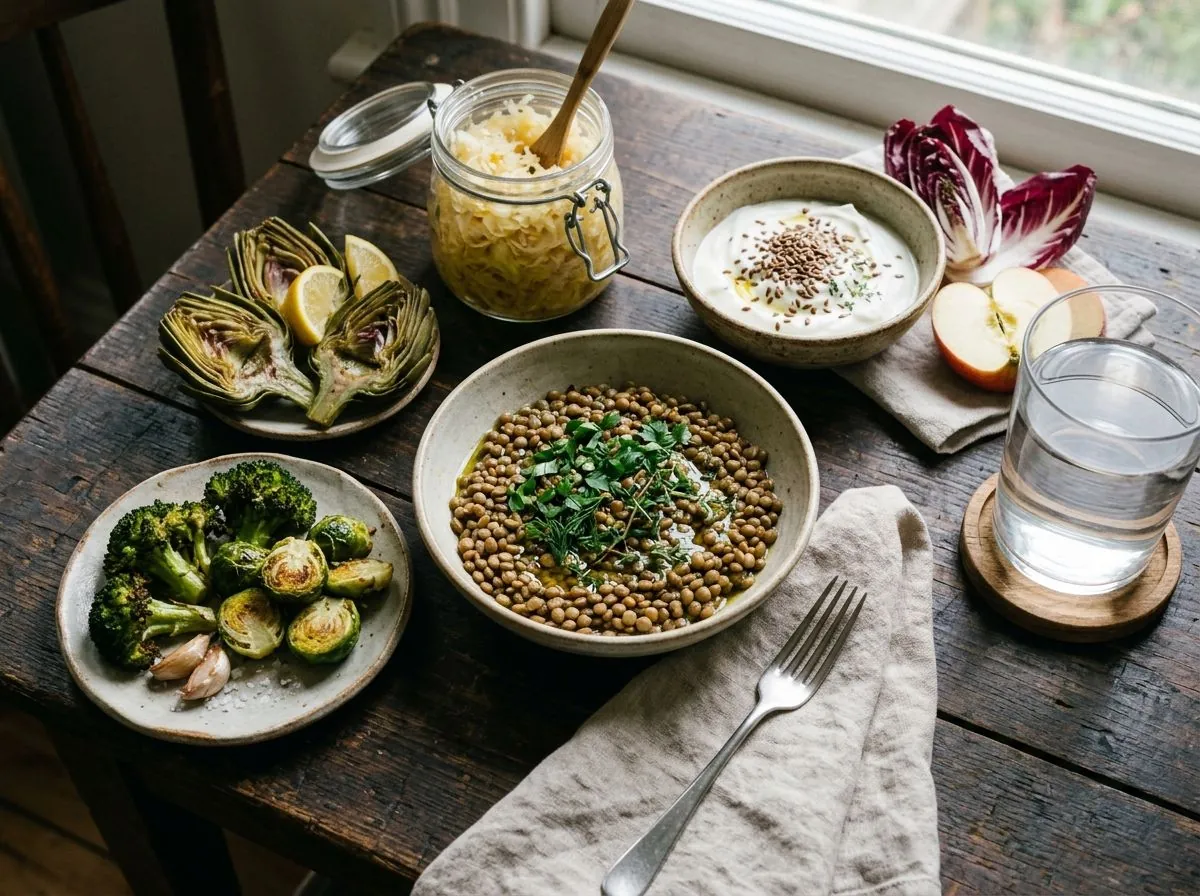
Fibre from lentils, broccoli and Jerusalem artichoke, live bacteria from raw sauerkraut, plus apple and a mustard dressing: the Lentil and sauerkraut bowl with apple and mustard puts this article on a plate. Ready in 30 minutes, in the Top 100 for the goal Digestion & Liver.
Instead of a cleanse: a little every day
What helps your liver and gut works over weeks, not over a weekend. The app makes it easier to keep going.
Frequently asked questions — liver detox foods
What should you detox first, the gut or the liver?
There is no order, because both organs work together anyway: the liver breaks substances down, the gut removes part of them, and the gut flora even affects liver fat. What helps both at the same time is the same: less alcohol and sugar, more fibre and fermented foods. Which foods combine both best is shown in the Digestion & Liver ranking.
Does a liver detox help you lose weight?
It works the other way round: losing weight helps the liver. If you are overweight, weight loss is the best-proven way to reduce liver fat and liver inflammation — from about 5 per cent, more clearly from 10 per cent. A detox diet lowers weight only briefly, mostly through water. With the Food Secrets app you can compare foods by sugar, fibre and calories.
How long does it take for the liver to recover?
That depends on the burden. In studies, values improved after only four to six weeks without alcohol or with less fructose. A fatty liver reverses over months when weight and diet change for good. If your liver values are raised, have them checked by your doctor. The Food Rankings show which foods help most along the way.
What foods are good for a liver detox?
There is no fixed list, because "detox" is not a protected or medical term. What makes sense is what is good for you without the label too: vegetables, pulses, whole grains, fruit, nuts, fermented foods, water and unsweetened tea or coffee. It is worth cutting back on alcohol, sweet drinks, sweets and highly processed products. Save matching recipes with the recipe import in the Food Secrets app.
Does apple cider vinegar cleanse the gut?
There is no evidence for that. In small studies, apple cider vinegar can slightly dampen the rise in blood sugar after a meal; nothing more is certain. If you use it, take it diluted or in a salad dressing, never neat. Fibre and fermented foods do more for the gut — sorted in the Digestion & Liver ranking.
How do I rebuild my gut flora after antibiotics?
In most people it recovers by itself. You can support that with a high-fibre diet, fermented foods such as plain yoghurt, kefir and sauerkraut, and as many different plants as possible. Probiotics can prevent diarrhoea during the course; whether they help afterwards is unclear. You will find fermented and high-fibre foods in the Food Rankings of the Food Secrets app.
Which plant helps the liver?
The best studied are milk thistle and artichoke leaf extract: both lowered liver values in several studies, especially in fatty liver. Both are supplements, not foods, so discuss them with your doctor or pharmacist first. High-dose green tea and turmeric capsules can even strain the liver. On the plate, bitter and cabbage vegetables such as artichoke, chicory, dandelion and broccoli help through their fibre — all ranked in the Food Lab of the Food Secrets app.
Studies
- Klein AV, Kiat H. Detox diets for toxin elimination and weight management: a critical review of the evidence. J Hum Nutr Diet 2015;28(6):675–686. doi:10.1111/jhn.12286
- Egner PA, Chen JG, Zarth AT, et al. Rapid and sustainable detoxication of airborne pollutants by broccoli sprout beverage: results of a randomized clinical trial in China. Cancer Prev Res 2014;7(8):813–823. doi:10.1158/1940-6207.CAPR-14-0103
- Chen JG, Johnson J, Egner P, et al. Dose-dependent detoxication of the airborne pollutant benzene in a randomized trial of broccoli sprout beverage in Qidong, China. Am J Clin Nutr 2019;110(3):675–684. doi:10.1093/ajcn/nqz122
- Mehta G, Macdonald S, Cronberg A, et al. Short-term abstinence from alcohol and changes in cardiovascular risk factors, liver function tests and cancer-related growth factors: a prospective observational study. BMJ Open 2018;8(5):e020673. doi:10.1136/bmjopen-2017-020673
- Simons N, Veeraiah P, Simons PIHG, et al. Effects of fructose restriction on liver steatosis (FRUITLESS); a double-blind randomized controlled trial. Am J Clin Nutr 2021;113(2):391–400. doi:10.1093/ajcn/nqaa332
- Vilar-Gomez E, Martinez-Perez Y, Calzadilla-Bertot L, et al. Weight Loss Through Lifestyle Modification Significantly Reduces Features of Nonalcoholic Steatohepatitis. Gastroenterology 2015;149(2):367–378. doi:10.1053/j.gastro.2015.04.005
- EASL, EASD, EASO. Clinical Practice Guidelines on the management of metabolic dysfunction-associated steatotic liver disease (MASLD). J Hepatol 2024;81(3):492–542. doi:10.1016/j.jhep.2024.04.031
- Haigh L, Kirk C, El Gendy K, et al. The effectiveness and acceptability of Mediterranean diet and calorie restriction in non-alcoholic fatty liver disease (NAFLD): A systematic review and meta-analysis. Clin Nutr 2022;41(9):1913–1931. doi:10.1016/j.clnu.2022.06.037
- Kennedy OJ, Roderick P, Buchanan R, et al. Systematic review with meta-analysis: coffee consumption and the risk of cirrhosis. Aliment Pharmacol Ther 2016;43(5):562–574. doi:10.1111/apt.13523
- Lange M, Nadkarni D, Martin L, et al. Intermittent fasting improves hepatic end points in nonalcoholic fatty liver disease: A systematic review and meta-analysis. Hepatol Commun 2023;7(8):e0212. doi:10.1097/HC9.0000000000000212
- So D, Whelan K, Rossi M, et al. Dietary fiber intervention on gut microbiota composition in healthy adults: a systematic review and meta-analysis. Am J Clin Nutr 2018;107(6):965–983. doi:10.1093/ajcn/nqy041
- Wastyk HC, Fragiadakis GK, Perelman D, et al. Gut-microbiota-targeted diets modulate human immune status. Cell 2021;184(16):4137–4153. doi:10.1016/j.cell.2021.06.019
- Ni Y, Qian L, Siliceo SL, et al. Resistant starch decreases intrahepatic triglycerides in patients with NAFLD via gut microbiome alterations. Cell Metab 2023;35(9):1530–1547. doi:10.1016/j.cmet.2023.08.002
- Shishehbor F, Mansoori A, Shirani F. Vinegar consumption can attenuate postprandial glucose and insulin responses; a systematic review and meta-analysis of clinical trials. Diabetes Res Clin Pract 2017;127:1–9. doi:10.1016/j.diabres.2017.01.021
- Launholt TL, Kristiansen CB, Hjorth P. Safety and side effects of apple vinegar intake and its effect on metabolic parameters and body weight: a systematic review. Eur J Nutr 2020;59(6):2273–2289. doi:10.1007/s00394-020-02214-3
- Hempel S, Newberry SJ, Maher AR, et al. Probiotics for the prevention and treatment of antibiotic-associated diarrhea: a systematic review and meta-analysis. JAMA 2012;307(18):1959–1969. doi:10.1001/jama.2012.3507
- Suez J, Zmora N, Zilberman-Schapira G, et al. Post-Antibiotic Gut Mucosal Microbiome Reconstitution Is Impaired by Probiotics and Improved by Autologous FMT. Cell 2018;174(6):1406–1423. doi:10.1016/j.cell.2018.08.047
- Li S, Duan F, Li S, et al. Administration of silymarin in NAFLD/NASH: A systematic review and meta-analysis. Ann Hepatol 2024;29(2):101174. doi:10.1016/j.aohep.2023.101174
- Holtmann G, Adam B, Haag S, et al. Efficacy of artichoke leaf extract in the treatment of patients with functional dyspepsia: a six-week placebo-controlled, double-blind, multicentre trial. Aliment Pharmacol Ther 2003;18(11-12):1099–1105. doi:10.1046/j.1365-2036.2003.01767.x
- Moradi S, Shokri-Mashhadi N, Saraf-Bank S, et al. The effects of Cynara scolymus L. supplementation on liver enzymes: A systematic review and meta-analysis. Int J Clin Pract 2021;75(11):e14726. doi:10.1111/ijcp.14726
- Ingrosso MR, Ianiro G, Nee J, et al. Systematic review and meta-analysis: efficacy of peppermint oil in irritable bowel syndrome. Aliment Pharmacol Ther 2022;56(6):932–941. doi:10.1111/apt.17179
- Melzer J, Rösch W, Reichling J, et al. Meta-analysis: phytotherapy of functional dyspepsia with the herbal drug preparation STW 5 (Iberogast). Aliment Pharmacol Ther 2004;20(11-12):1279–1287. doi:10.1111/j.1365-2036.2004.02275.x
- Yaskolka Meir A, Rinott E, Tsaban G, et al. Effect of green-Mediterranean diet on intrahepatic fat: the DIRECT PLUS randomised controlled trial. Gut 2021;70(11):2085–2095. doi:10.1136/gutjnl-2020-323106
- Hu J, Webster D, Cao J, et al. The safety of green tea and green tea extract consumption in adults – Results of a systematic review. Regul Toxicol Pharmacol 2018;95:412–433. doi:10.1016/j.yrtph.2018.03.019
- He Y, Chen X, Li Y, et al. Curcumin supplementation alleviates hepatic fat content associated with modulation of gut microbiota-dependent bile acid metabolism in patients with nonalcoholic simple fatty liver disease: a randomized controlled trial. Am J Clin Nutr 2024;120(1):66–79. doi:10.1016/j.ajcnut.2024.05.017
- Lombardi N, Crescioli G, Maggini V, et al. Acute liver injury following turmeric use in Tuscany: An analysis of the Italian Phytovigilance database and systematic review of case reports. Br J Clin Pharmacol 2021;87(3):741–753. doi:10.1111/bcp.14460
- Anh NH, Kim SJ, Long NP, et al. Ginger on Human Health: A Comprehensive Systematic Review of 109 Randomized Controlled Trials. Nutrients 2020;12(1):157. doi:10.3390/nu12010157
- Clare BA, Conroy RS, Spelman K. The diuretic effect in human subjects of an extract of Taraxacum officinale folium over a single day. J Altern Complement Med 2009;15(8):929–934. doi:10.1089/acm.2008.0152
- Williams G, Stothart CI, Hahn D, et al. Cranberries for preventing urinary tract infections. Cochrane Database Syst Rev 2023;11:CD001321. doi:10.1002/14651858.CD001321.pub7
The rank figures come from the Food Secrets catalogue (more than 1000 foods, Digestion & Liver rank) and are given as bands, not as exact positions.
- Digestion & Liver — the nutrition goal in the app – all foods by what they do for your gut and liver.
- Longevity nutrition — meaning, healthspan & long life – what healthy ageing has to do with food.
- Food Rankings – more than 1000 foods across 15+ health goals.
- Lentil and sauerkraut bowl with apple and mustard – the recipe for this article, ready in 30 minutes.
Start for free
See foods for your gut and liver sorted, save recipes with one tap and put the ingredients straight onto your shopping list.


Note: this information does not replace medical advice. Raised liver values, liver disease or ongoing digestive problems should be checked by a doctor. Discuss supplements such as milk thistle, artichoke, turmeric, green tea extract or probiotics with your doctor or pharmacist first.