
Diet for autoimmune disease — what the gut microbiome has to do with it
Hashimoto's, rheumatoid arthritis, Crohn's disease, psoriasis: anyone living with an autoimmune condition eventually asks what belongs on the plate. This article shows what research says about it — and where the gut comes in.
Three points first
- Treatment stays with your doctor. Diet is the part you shape yourself every day — and it fits any treatment plan.
- The gut microbiome helps train the immune system. Fibre and fermented foods are the two levers that have been studied best in people.
- In a large trial, vitamin D cut the risk of developing a new autoimmune disease by just over a fifth — in healthy older adults who had no such condition at the start.
Why the gut has a say in the immune system
In an autoimmune disease, the immune system turns against the body itself: against the thyroid in Hashimoto's, against the joints in rheumatoid arthritis, against the gut wall in Crohn's disease. So the immune system does not need to get stronger, it needs to tell things apart better — dangerous from harmless. That is why this goal in the Food Secrets app is called Immune balance.
A large part of that learning happens in the gut. The trillions of bacteria living there, the gut microbiome , are in constant exchange with the immune cells of the gut lining. A widely cited review in the journal Cell describes how the microbiome helps build and train the immune system — including the brakes that stop it from reacting to harmless things.
The researchers consider it possible that part of the rise in autoimmune and inflammatory diseases in wealthy countries is linked to this: a less diverse microbiome due to changed diets and frequent antibiotics. It is a well-founded hypothesis, not proof.
The microbiome is one of the five defence systems that the app scores for every food — more on the Longevitypage. How digestion, the heart and circulation, the lymphatic and the respiratory system work together is shown on the Body systemspage. Allergies are also about an immune system that reacts to something harmless.
Does diet affect autoimmune diseases? What research knows
- Vitamin D and omega-3 (VITAL): In a large US trial, 25,871 healthy men aged 50 and over and women aged 55 and over took vitamin D (2,000 IU a day), omega-3 fatty acids from fish oil, both, or a placebo for around five years. With vitamin D, 22 per cent fewer developed a new autoimmune disease, such as rheumatoid arthritis, psoriasis or autoimmune thyroid disease. With omega-3 it was 15 per cent fewer, but that was not statistically significant. The trial tested supplements in people without such a condition — it does not show what happens in people who are already affected.
- Fermented foods: In a Stanford University study, healthy adults ate more yoghurt, kefir, sauerkraut, kimchi or kombucha every day for several weeks. The diversity of their gut bacteria rose and several inflammatory markers in the blood fell. In the comparison group eating lots of fibre, diversity did not change — but the bacteria's ability to break down fibre did.
- Ultra-processed foods: In an observational study of more than 116,000 adults from 21 countries, those who ate five or more servings of ultra-processed food a day developed chronic inflammatory bowel disease about 80 per cent more often than those eating less than one serving. That is an association, not proof — but a clear one.
For people who already live with an autoimmune disease, there is no diet that has been shown to work as a treatment. What emerges across many studies is a pattern: plenty of vegetables, pulses, whole grains, nuts and seeds, oily fish and fermented foods — and little ultra-processed food. That is exactly the pattern the immune balance ranking reflects.
Which foods support immune balance best
In the Food Secrets app, the Immune balance ranking scores more than 1000 foods. It mainly counts omega-3 and polyphenols, plus vitamin D, a good microbiome and probiotics. Vitamin D, vitamin C, zinc and selenium contribute to the normal function of the immune system. Histamine, histamine liberators, common allergens, sugar, alcohol and heavy processing cost points.
- Top 10: chia seeds, linseed, hemp seeds, mackerel and herring.
- Top 20: cocoa powder, walnuts and trout.
- Top 50: sardines, salmon, porcini, chanterelles, elderberries, sesame, pistachios, blackcurrants and garlic.
- Top 100: kale, broccoli sprouts, pumpkin seeds, button mushrooms, blueberries, natto, raspberries, almonds, oat bran, raw broccoli, barley and hazelnuts.
- Top 250: oats, olive oil, kombucha, spinach, Jerusalem artichoke, rocket, Greek yoghurt, kefir and kimchi.
- Top 500: strawberries, leeks, natural yoghurt, chicory, apple, onions and avocado.
- Herbs: marjoram in the Top 10, oregano in the Top 10, parsley in the Top 50, dill in the Top 50, turmeric in the Top 50, cinnamon in the Top 50, nettle in the Top 100.
Two things stand out. Fermented foods are not right at the top, even though they are good for the microbiome: kefir, kimchi and kombucha sit in the Top 250, sauerkraut in the lower half. The reason is histamine, which forms during fermentation — people who are sensitive to it notice. And for the microbiome itself the order looks different: in the defence system Microbiome avocado, oats and oat bran, whole grains such as barley, rye and spelt, linseed and walnuts get the highest scores. Their fibre is what gut bacteria live on.
You will find the full ranking on the Immune balance page and in the Food Rankings.
Autoimmune disease: foods to eat less often
There is no need for a ban. What counts is what ends up on the plate on most days. Far down the immune balance ranking you will find:
- Sugar and sweetened drinks: table sugar, cola, lemonade.
- Alcohol: beer and red wine — red wine also because of its histamine.
- Sausages: bratwurst and smoked salami, because of processing, salt and histamine.
- Ultra-processed food: corn chips and many ready meals. White bread sits in the lower half.
Tomatoes and pineapple are in the lower half too. They are not unhealthy, but they count as histamine liberators. If you tolerate them well, there is no need to avoid them. If you notice symptoms with certain foods, it is best to work it out with a dietitian rather than cutting out whole food groups on suspicion.
Hashimoto's: which foods to avoid?
No question about Hashimoto's is searched as often as this one. The honest answer is shorter than many lists online:
- Gluten: A gluten-free diet is necessary with confirmed coeliac disease. It is more common in people with Hashimoto's, so a test with your doctor is worthwhile. Without coeliac disease the benefit is unclear: a 2025 analysis found only three small studies with 110 people in total. The gluten-free diet had no proven effect on thyroid levels, and the quality of the evidence was very low.
- Very high iodine: In a Chinese study of around 3,000 people, autoimmune thyroid disease developed more often over five years where more than enough or too much iodine was eaten. So take care with seaweed and seaweed supplements, which can contain a great deal of iodine. How much iodine is right for you is something to discuss with your doctor.
- Everything else as above: plenty of vegetables, pulses, whole grains, nuts, seeds and fish, little sugar and little ultra-processed food.
Seaweed such as nori ranks high in the immune balance ranking, by the way, because of its nutrients. For people with Hashimoto's, the iodine note comes first.
Strengthening the gut microbiome after antibiotics
Antibiotics also hit the gut microbiome. A Danish study followed this closely: in twelve healthy men, the microbiome after a four-day course of antibiotics had largely recovered within about six weeks. Some bacterial species were still missing after six months, though.
Probiotics are no shortcut here: in an Israeli study, people's own gut microbiome recovered even more slowly with probiotics after the course than without. You can support the recovery with what is good for the microbiome anyway:
- Eat plenty of fibre: pulses, whole grains, oats, vegetables, fruit.
- Include fermented foods regularly: natural yoghurt, kefir, kimchi or sauerkraut, if you tolerate histamine well.
- Lots of different plants over the week, instead of always the same three.
More on this in the article Liver detox foods.
A plate that suits this article
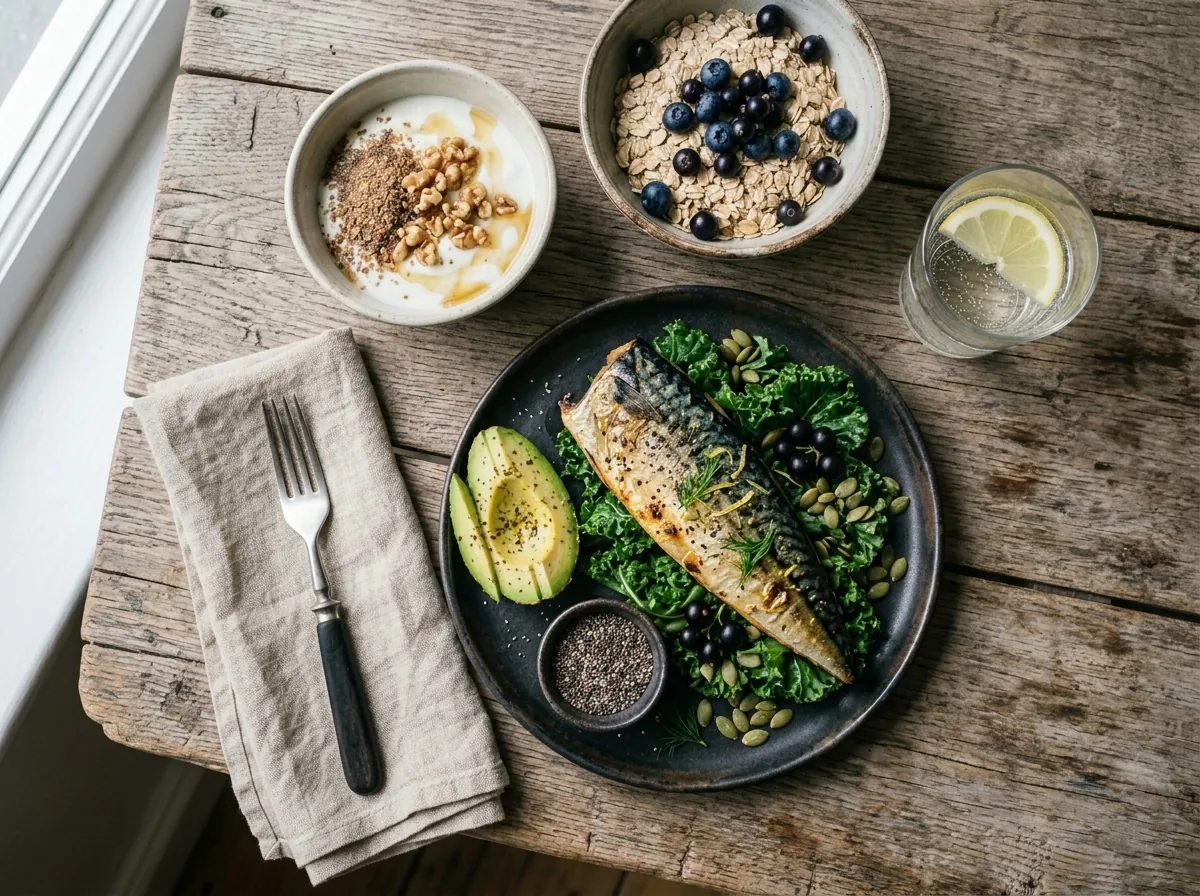
Trout brings omega-3, with broccoli, quinoa, turmeric and fresh herbs – ingredients on common lists for a low-histamine diet: the herb-crusted trout with broccoli and quinoa is ready in about 30 minutes and puts omega-3 and fibre on one plate.
A plate for immune balance, every day
What is good for the microbiome and the immune system works over weeks. The app makes it easier to keep going.
Frequently asked questions — diet for autoimmune disease
What is a good diet for autoimmune disease?
There is no diet that has been shown to work as a treatment. Well founded is a pattern that supports the microbiome and immune balance: plenty of vegetables, pulses, whole grains, nuts and seeds, oily fish, fermented foods and little ultra-processed food. Which foods fit best is shown in the immune balance ranking.
Which foods should you avoid with an autoimmune disease?
There are no strict bans. Sugar and sweetened drinks, alcohol, sausages and ultra-processed foods sit far down the immune balance ranking. A large observational study found a clearly higher risk of chronic inflammatory bowel disease with a lot of ultra-processed food. What sits further down is shown in the Food Rankings of the Food Secrets app.
Hashimoto's: what should you not eat?
Gluten-free only with confirmed coeliac disease — without it, a benefit for the thyroid has not been shown. Take care with very high iodine, for example from seaweed and seaweed supplements. Otherwise the same applies as with other autoimmune diseases: plenty of vegetables, whole grains, nuts, seeds and fish, little sugar. You can compare iodine-rich foods and their values in the Food Lab of the Food Secrets app.
How do I strengthen the gut microbiome after antibiotics?
In most people the microbiome recovers on its own within a few weeks. You can support that with fibre from pulses, whole grains and vegetables, with fermented foods and with lots of different plants over the week. Whether a probiotic makes sense is best asked at the pharmacy. Foods for the gut microbiome are shown on the Longevity page with the microbiome defence system.
Does a gluten-free diet help with autoimmune diseases?
With coeliac disease, yes — there it is the foundation. For other autoimmune diseases a benefit has not been shown, and cutting out gluten without a reason often means losing whole grains and with them fibre for the microbiome. Have possible coeliac disease checked with a test at your doctor first. Gluten-free whole-grain options such as oats, millet or teff are in the Food Lab of the Food Secrets app.
What diet suits rheumatoid arthritis?
Treatment belongs with your rheumatologist. As a diet, the same pattern fits that counts for inflammation and immune balance: vegetables, pulses, whole grains, nuts, olive oil and oily fish, little sugar, sausage and alcohol. Foods that fit are shown on the Inflammation page with its ranking in the Food Secrets app.
How are the gut microbiome and the immune system connected?
Gut bacteria are in constant exchange with the immune cells in the gut lining and help train when the immune system reacts and when it stays calm. A diverse microbiome needs fibre and benefits from fermented foods. How much a food brings to the gut microbiome is shown by the Food Secrets app in the microbiome defence system.
Studies
- Hahn J, Cook NR, Alexander EK, et al. Vitamin D and marine omega 3 fatty acid supplementation and incident autoimmune disease: VITAL randomized controlled trial. BMJ 2022;376:e066452. doi:10.1136/bmj-2021-066452
- Belkaid Y, Hand TW. Role of the microbiota in immunity and inflammation. Cell 2014;157(1):121–141. doi:10.1016/j.cell.2014.03.011
- Wastyk HC, Fragiadakis GK, Perelman D, et al. Gut-microbiota-targeted diets modulate human immune status. Cell 2021;184(16):4137–4153. doi:10.1016/j.cell.2021.06.019
- Narula N, Wong ECL, Dehghan M, et al. Association of ultra-processed food intake with risk of inflammatory bowel disease: prospective cohort study. BMJ 2021;374:n1554. doi:10.1136/bmj.n1554
- Araújo LB, Coutinho-Lima CRO, et al. Effects of Gluten-Free Diet in Non-Celiac Hashimoto's Thyroiditis: A Systematic Review and Meta-Analysis. Nutrients 2025;17(21):3437. doi:10.3390/nu17213437
- Teng W, Shan Z, Teng X, et al. Effect of iodine intake on thyroid diseases in China. N Engl J Med 2006;354(26):2783–2793. doi:10.1056/NEJMoa054022
- Palleja A, Mikkelsen KH, Forslund SK, et al. Recovery of gut microbiota of healthy adults following antibiotic exposure. Nat Microbiol 2018;3(11):1255–1265. doi:10.1038/s41564-018-0257-9
- Suez J, Zmora N, Zilberman-Schapira G, et al. Post-Antibiotic Gut Mucosal Microbiome Reconstitution Is Impaired by Probiotics and Improved by Autologous FMT. Cell 2018;174(6):1406–1423. doi:10.1016/j.cell.2018.08.047
The rank figures come from the Food Secrets catalogue (more than 1000 foods, immune balance ranking and microbiome defence system) and are given as bands, not as exact positions.
- Immune balance — the nutrition goal in the app – low-histamine foods and every food by what it brings to immune balance.
- Longevity – the microbiome and the body's other four defence systems.
- Body systems – digestion, heart and circulation, the lymphatic and respiratory systems, and what supports them.
- Allergies and hay fever – when the immune system reacts to something harmless.
- Liver detox foods — what really helps – gut microbiome, fibre and the time after antibiotics.
- Food Rankings – more than 1000 foods by 15+ health goals.
Start for free now
See foods sorted by immune balance, import recipes with one click and put the ingredients straight onto your shopping list.


Note: this information does not replace medical advice. An autoimmune disease belongs in medical care; discuss bigger changes to your diet and supplements such as vitamin D with your doctor or dietitian first.