
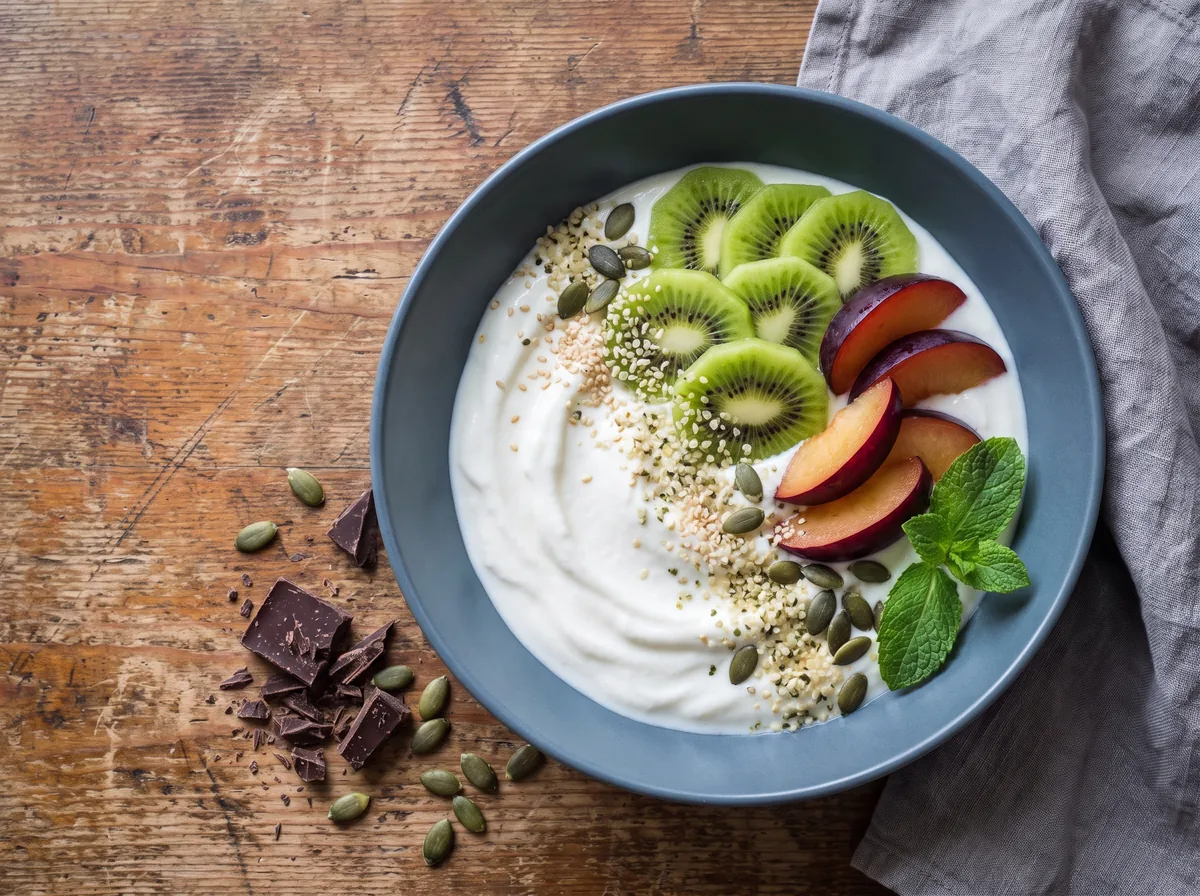
A longevity recipe for ten minutes: milk kefir with kiwi, plum, mint and three kinds of seed. Two of the seven ingredients sit in the Top 50 on their own – peppermint and sesame – and in the Food Secrets app the bowl lands in the Top 250 of 1000+ rated foods for the longevity goal.
Open the recipe straight in the Food Secrets app. The app reads the ingredients, links each one to the nutrient database and recalculates the rank for your goal.
Ingredients for 2 servings
- Milk kefir300 g
- Kiwi100 g (1 fruit)
- Plums100 g (2 fruits)
- Pumpkin seeds20 g
- Sesame seeds15 g
- Hemp seeds, hulled15 g
- Peppermint, fresh5 g
No sugar, no honey. The kiwi and the plum bring enough sweetness – and what honey costs is calculated further down.
Method
- Toast the pumpkin and sesame seeds in a dry pan for 2–3 minutes, until the sesame starts to pop. Tip them onto a plate to cool. This is the only step with heat and the only one that makes flavour rather than just texture.
- Divide the kefir between two bowls and smooth it with a spoon.
- Peel and slice the kiwi. Stone the plums and cut them into wedges. Lay both out in rows on the kefir.
- Scatter the toasted seeds, the sesame and the hemp over the top.
- Pick the mint leaves off the stems, tear the large ones once and spread them over. Do not chop them – torn leaves release more aroma than cut ones.
- Eat straight away. Kefir draws water out of the fruit, and after half an hour the bowl turns watery.
The ingredients and their rank for longevity
Every ingredient carries its band from the Food Secrets longevity ranking. A band is stable – a place number changes with every data release, and the app shows you the exact figure.
- Top 50PeppermintWell up this ranking. Rosmarinic acid and menthol at a density no vegetable reaches.
- Top 50Sesame seedsSesamin and sesamolin, plus copper and calcium. Unhulled, or you lose the coat that carries the lignans.
- Top 100KiwiMore vitamin C than an orange, plus actinidin, which helps break protein down.
- Top 250Hemp seedsOmega-3 and omega-6 in the ratio the body likes, and a complete amino acid profile.
- Top 250Pumpkin seedsZinc, magnesium and phytosterols. Twenty grams cover a good part of the daily magnesium need.
- Top 500PlumPolyphenols and sorbitol. The dark skin carries most of it – which is why you do not peel it.
- Top 500Milk kefirThe base, not the star. Kefir brings live cultures and protein – for longevity on its own it only sits mid-field.
Two of the seven ingredients sit in the Top 50 on their own – peppermint and sesame. Averaged and weighted by category, the bowl lands in the Top 250.
For more enjoyment – and what it costs
Kefir is sharp, and seeds are dry. These three additions round the bowl off. We calculated each one so you can decide for yourself:
- Dark chocolate, 15 g shaved – almost free. Bitter against the acidity, and the bowl stays in the Top 250. Take 70 % or darker.
- Blueberries, 60 g – they make it better. Sweetness, colour, and the rank actually improves, and the bowl stays in the Top 250. If you add only one thing, add this.
- Honey, 1 tsp – the classic, and the most expensive. The bowl stays in the Top 250, but drops back the furthest. Still very good, but it is the biggest price of these three additions.
All three stay inside the best 250 of 1000+ foods. A bowl you enjoy beats the perfect one you leave standing.
Variations
Every variation is calculated. Where the band changes, it says so.
- With yoghurt instead of kefir: 300 g of plain yoghurt. The bowl stays in the Top 250 – yoghurt and kefir rank almost level for longevity. What you lose are the yeasts: kefir brings a wider range of strains than yoghurt.
- As a breakfast that carries you: stir in 30 g of oats and let it stand for ten minutes. Far more filling, and the bowl stays in the Top 250.
- With raspberries instead of kiwi: 100 g of raspberries. The bowl then stays in the Top 250 but drops back; in summer it is the easier fruit.
- Not with pear: 100 g of pear in place of the plum costs several places – for longevity the pear sits far back. The plum sits in the Top 500 of this ranking, the pear behind it.

Ingredients onto the shopping list, recipe into the week plan – in one step.
Frequently asked questions about this recipe
What is milk kefir?
Milk kefir is milk fermented with a culture of bacteria and yeasts, the so-called kefir grain. It tastes sharper than yoghurt and carries a little carbon dioxide. Because yeasts are involved, kefir brings a wider range of micro-organisms than yoghurt, which works with bacteria alone.
Is kefir healthier than yoghurt?
For the longevity goal there is almost nothing between kefir and yoghurt in our ranking: with yoghurt the bowl stays in the Top 250. Kefir does bring a wider variety of cultures. Take whichever you like better – only what tastes good gets eaten.
Can I make kefir myself?
Yes. Put a kefir grain into 500 ml of milk, leave it at room temperature for 24 hours, strain it and start the grain again. It grows as it goes. Keep the jars clean and do not use an aluminium sieve.
Why kiwi and plum in particular?
Because the ranking says so. Kefir on its own only sits in the Top 500 for longevity – it does not carry the bowl. Kiwi sits in the Top 100 and plum in the Top 500, banana and pear behind them. With banana or pear the bowl stays in the Top 250; with pear it drops back.
Does the bowl work as an evening meal?
Yes, at 268 kcal per serving it is light. If you eat it as a main meal, take the oat variation – otherwise the hunger is back within two hours.
What does „Top 250“ mean at Food Secrets?
The app rates 1000+ foods against more than 25 scientific metrics and gives each a rank per goal. Top 250 means: averaged across all its ingredients, this recipe sits among the best 250 for the longevity goal. We name ranges rather than place numbers because the database keeps growing.
More healthy recipes and food rankings
- Longevity: app and food list for a longer life – the groundwork and the full ranking of foods for the longevity goal.
- Recipe generator: import and analyse healthy recipes – read in any recipe from the web, calculate the nutrients and build the shopping list automatically.
- All healthy recipes by goal – recipes for longevity, cancer risk, muscles, inflammation, heart, immune system, blood sugar and other health goals.
- Foods and body systems – which foods act on your cells, gut, nerves and digestion.
The bands on this page are a snapshot of the Food Secrets ranking. The database keeps growing, which is why we name ranges rather than place numbers – the app works out the current value at any time. The information provided is for general education and does not replace medical advice or treatment.