
Candida diet — foods to eat, foods to avoid and how long
Anyone who hears about gut yeast usually looks for a list first: what can I still eat, and what has to go? This article shows what the research on the Candida diet really supports, which foods contain proven antifungal compounds, and which ones you are better off eating less often.
Three things first
- Candida is part of the normal gut flora in most people. Finding it in a stool sample is not, on its own, a disease.
- A fungal infection belongs with a doctor — in the mouth, the genital area, on the feet, the nails or in the gut. Diet supports, it does not replace treatment.
- What diet can contribute: less sugar, more vegetables, fibre and fermented foods, plus herbs and spices with antifungal compounds — and steady blood sugar.
What is behind “gut yeast”
“Gut yeast” almost always means Candida albicans — a yeast. In a large US study of healthy volunteers, Candida albicans was found in about 8 out of 10 stool samples, and in almost two thirds of participants across a whole year. So the yeast is an ordinary resident, not an intruder.
It becomes a problem when the balance tips: after antibiotics, with weakened immunity, with poorly controlled diabetes or with certain medicines. Candida can then multiply more strongly — visible, for example, as a coating in the mouth or as a genital infection. Whether symptoms such as bloating or tiredness really come from gut yeast can only be clarified by a doctor; a stool test alone does not answer that.
What the Candida diet really delivers
The classic Candida diet cuts out sugar, white flour, fruit, yeast and often dairy too. For rules this strict there are only a few human studies — and their results are more mixed than most guides admit.
- Sugar: In a study in Würzburg, 28 healthy people ate a very sugary diet for a while. On average, the amount of Candida in mouth and stool did not rise — only in a few people who already had a lot of Candida in the mouth. A US study of 98 people found, by contrast, that those who had eaten a lot of carbohydrate in the previous days had more Candida in their stool. So sugar is not a switch, but it is a factor.
- Wheat and gluten: There is no study showing that wheat itself feeds Candida. But there are two links. First: white bread makes blood sugar rise fast. The international glycaemic index tables show bread in fast and slow versions, and pasta mostly slow. Second: a protein on the surface of Candida resembles the gluten protein gliadin. In a French study, people with a Candida infection and people with coeliac disease had more antibodies against both proteins than healthy people. The researchers suspect that a Candida infection may help trigger coeliac disease in genetically susceptible people. So if you react to gluten, you have one more reason to go easy on wheat.
- Diet on top of treatment: In a Serbian pilot study, 120 people with gut yeast overgrowth were given an antifungal medicine. 80 of them also changed their diet. After three months, 85 per cent of this group were free of the yeast overgrowth, compared with 42.5 per cent in the group on the medicine alone. The study was small — but it supports thinking about diet during and after treatment.
- Coconut fat: Mice fed a lot of coconut fat had clearly less Candida in the gut than mice fed beef tallow or soybean oil. In 12 premature babies, the amount of yeast in the stool fell while they were given medium-chain fats (as found in coconut fat). In adults, this has not been tested yet.
- Garlic: In the lab, it clearly inhibits Candida. In an Australian study, 63 women with genital Candida took garlic tablets or a placebo for two weeks. The amount of yeast did not differ, but the garlic group had more side effects. Garlic remains a good seasoning — an effect as a cure has not been shown.
- Oregano: In the lab, oregano oil completely inhibited Candida even in small amounts. In an experiment with mice that had a severe Candida infection, 80 per cent of the animals given oregano oil in olive oil for 30 days survived. The animals given olive oil alone died within 10 days. A 2025 review confirms that oregano oils inhibit many kinds of fungi in the lab; the key compounds are carvacrol and thymol. Human studies are still missing, and the oil is far more concentrated than the herb. As a seasoning, oregano is in the top 10 of the Antimicrobial ranking.
- Probiotic bacteria: In a Finnish study, 276 older people ate a cheese with or without probiotic bacteria every day for 16 weeks. In the probiotic group, the share with a lot of yeast in the mouth fell from 30 to 21 per cent; in the comparison group it rose from 28 to 34 per cent.
The bottom line: The best support is not for a strict list of bans, but for a simple pattern: less sugar, more vegetables and fibre, fermented foods — alongside treatment and afterwards.
Candida diet: foods to avoid
You do not need a ban for life. What counts is what you eat on most days. At the bottom of the Antimicrobial ranking are almost only foods with a lot of sugar:
- Sugar in every form: white and brown sugar, glucose, icing sugar. They come last in the ranking.
- Syrups as a “healthy” substitute: agave syrup, maple syrup and molasses are more than half sugar and also sit right at the bottom.
- Sweets: boiled sweets, caramels, gummies, marzipan, milk chocolate and jam.
- Dried fruit: dates, raisins, dried mango and banana chips concentrate the fruit sugar.
- Sweetened drinks: cola and lemonade rank far down, fruit juice in the lower half.
And wheat, yeast, fruit? White flour, white bread and pasta sit in the bottom third of the ranking: they bring little. White bread also makes blood sugar rise fast, and if you react to gluten, you have one more reason to hold back (see the studies above). Whole grains, oats and pulses are better. The yeast in bread is a different species from Candida and is killed by baking; there is no study behind a yeast ban. Fresh fruit in normal amounts belongs to a balanced diet — its fibre slows the sugar.
Honey is a special case: It ranks in the Top 100 because it contains antibacterial compounds. But it is three quarters sugar. If you want to eat less sugar, treat it like sugar.
Candida diet: foods that bring antifungal compounds
In the Food Secrets app, the Antimicrobial rank rates over 1000 foods by how much they bring of compounds with antifungal, antibacterial and antiviral activity — such as the sulphur compounds from garlic and onions, thymoquinone from black seed or curcumin from turmeric. Sugar and heavy processing cost points. Most of these effects were measured in the lab; in humans they have hardly been tested for fungal infections.
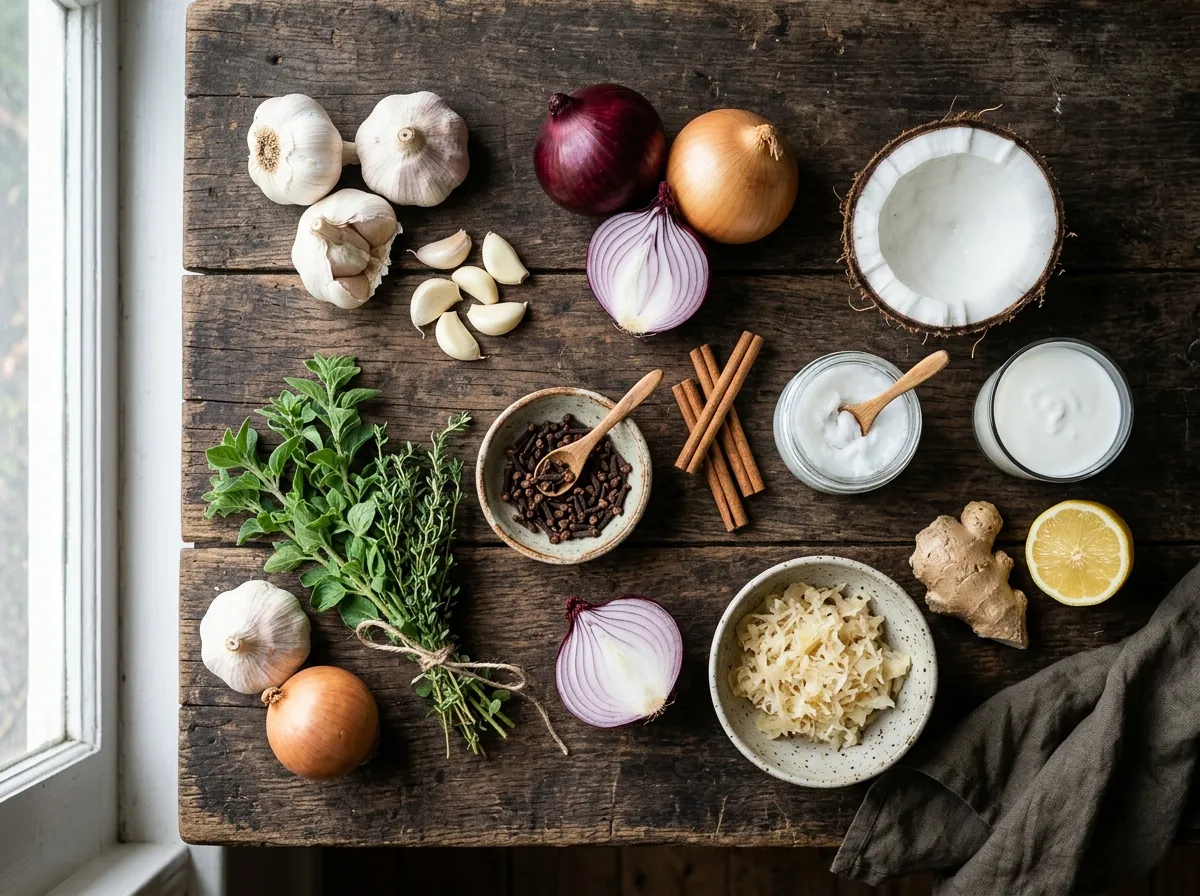
- Top 10: garlic, onion, cinnamon, cloves and apple cider vinegar.
- Top 20: ginger, tempeh, kimchi, plain yoghurt and kefir.
- Top 50: chilli, sauerkraut, coconut fat, leek, shallots, lemon and turmeric.
- Top 100: olive oil, coconut and raw broccoli.
- Herbs: oregano, thyme and sage in the Top 10, marjoram in the Top 20, rosemary in the Top 50.
Two things stand out. Fermented foods rank high: kimchi, plain yoghurt and kefir bring live lactic acid bacteria, which compete with yeasts in the gut for space and food. And coconut fat ranks in the Top 50, olive oil only in the Top 100: coconut fat contains medium-chain fatty acids such as caprylic acid, which inhibit Candida in the lab.
You will find the full ranking on the page Antimicrobial — the nutrition goal in the app and in the Food Rankings.
Athlete's foot: diet, a baking-soda foot bath and dry feet
Athlete's foot and nail fungus are usually caused by dermatophytes (filamentous fungi), not by Candida. You catch them from damp floors in bathrooms, showers and changing rooms; warm, damp shoes help the fungus. There is no diet that clears athlete's foot directly.
Indirectly, though, diet plays a part — through blood sugar. In a review of ten studies with 5664 people with diabetes, almost one in three had nail fungus, more often with higher long-term blood sugar. Genital yeast infections and inflammation under dentures are also more common with diabetes. Well-controlled blood sugar is therefore one of the few levers diet really has.
Baking soda in the lab: In a lab study from Strasbourg, baking soda (sodium bicarbonate) at just 10 grams per litre inhibited the growth of 80 per cent of the 70 fungal strains tested from skin and nail infections. On 24 skin and nail samples from patients, the fungus stopped growing completely in 19. How baking soda works is not yet known, and nobody has tested a foot bath in people. It still fits as a low-cost addition to foot care: 2 to 4 tablespoons of baking soda in 3 litres of warm water match roughly the amounts from the lab.
Air for your feet: Among 420 patients of a Japanese dermatology practice, those with a warm, damp climate inside their shoes had athlete's foot much more often. Among 729 soldiers, athlete's foot was rarer when they wore two or more pairs of boots in turn. So: dry your feet well after showering, also between the toes; go barefoot at home; alternate your shoes so each pair can dry for a day; change socks every day and wear flip-flops in bathrooms and changing rooms.
For the treatment itself, a pharmacy or a doctor is the right way.
How long does a Candida diet take?
There is no fixed duration from studies. In the Serbian pilot study, the diet was kept up for three months during and after treatment — and the difference only showed after those three months, not after ten days.
More helpful than a cure with an end date is a pattern that stays: less sugar and fewer sweetened drinks, vegetables and pulses every day, plain yoghurt, kefir or sauerkraut regularly, herbs and spices instead of sugar for flavour. After a course of antibiotics this is especially worthwhile, because the gut flora then reorganises itself — more on that in the article Liver and gut detox.
A recipe with onion, garlic and ginger
Onion, garlic, ginger and thyme – ingredients from the top ranks – carry the onion, garlic and ginger soup with thyme and turmeric – with no sugar at all. In the app, the soup sits in the Top 20 for the Antimicrobial goal.
Less sugar, more flavour — every day
What strengthens the gut flora works over weeks. The app makes it easier to stick with it.
Frequently asked questions — Candida diet
What can you eat on a Candida diet?
Almost everything that makes up a balanced diet: vegetables, pulses, wholegrains, nuts, eggs, fish, meat, fresh fruit in normal amounts and fermented foods such as plain yoghurt, kefir and sauerkraut. Herbs and spices such as oregano, thyme, cinnamon, cloves and ginger bring antifungal compounds and replace sugar as a source of flavour. Which of these bring the most is shown in the Antimicrobial ranking in the Food Secrets app.
Which foods should you avoid with gut yeast?
Above all sugar: table sugar, glucose, syrups such as agave or maple syrup, sweets, dried fruit and sweetened drinks. They sit at the bottom of the Antimicrobial ranking. White flour and white bread bring little and make blood sugar rise fast; there is no study behind a yeast ban. You can spot sugary foods in the Food Lab of the Food Secrets app at a glance.
How long does a Candida diet take?
There is no fixed duration. In the only study that combined diet and treatment, the change was kept up for three months, and the difference only showed afterwards. Better than a cure with an end date is a pattern that stays: less sugar, more vegetables and fermented foods. Import suitable recipes with the recipe import of the Food Secrets app.
Can I eat mushrooms with Candida?
Yes. Edible mushrooms such as button mushrooms, porcini or shiitake have nothing to do with the yeast Candida and do not feed it. They bring fibre and little sugar. One example is the mushroom pan with chilli, oregano and sesame from the Food Secrets recipes.
Does garlic help with Candida?
In the lab, garlic clearly inhibits Candida. In humans this has hardly been tested: in a study of 63 women, garlic tablets did not change the amount of genital yeast but caused more side effects. As a seasoning in everyday cooking, garlic remains a good companion — it ranks in the Top 10 of the Food Rankings.
Is wheat bad for Candida?
There is no study showing that wheat itself feeds Candida. But white bread makes blood sugar rise fast, and a Candida protein resembles the gluten protein gliadin — for people with coeliac disease or gluten sensitivity, one more reason to go easy on wheat. Whole grains, oats and pulses are the better choice. You can compare how grains and bread score in the Food Rankings of the Food Secrets app.
What does a baking-soda foot bath do for athlete's foot?
In the lab, baking soda from 10 grams per litre inhibited most fungi from skin and nail infections; a foot bath has not been tested in people. As an addition to foot care, 2 to 4 tablespoons in 3 litres of warm water fit. Dry feet matter at least as much: dry them well, let them breathe barefoot and alternate your shoes. If the fungus stays, a pharmacy or a doctor is the right way. Foods that keep blood sugar steady are shown in the Food Secrets app's Food Rankings.
Can a poor diet cause athlete's foot?
Not directly: athlete's foot comes from infection, usually via damp floors. Persistently high blood sugar does make fungal infections more likely, on the nails as well as in the genital area. Foods that keep blood sugar steady are in the Food Rankings of the Food Secrets app.
Is fruit allowed with gut yeast?
Fresh fruit in normal amounts, yes — its fibre slows the fruit sugar. Hold back on dried fruit and fruit juice, where the sugar is concentrated. How much sugar a fruit brings, you can compare in the Food Lab of the Food Secrets app.
Studies
- Nash AK, Auchtung TA, Wong MC, et al. The gut mycobiome of the Human Microbiome Project healthy cohort. Microbiome 2017;5(1):153. doi:10.1186/s40168-017-0373-4
- Weig M, Werner E, Frosch M, Kasper H. Limited effect of refined carbohydrate dietary supplementation on colonization of the gastrointestinal tract of healthy subjects by Candida albicans. Am J Clin Nutr 1999;69(6):1170–1173. doi:10.1093/ajcn/69.6.1170
- Hoffmann C, Dollive S, Grunberg S, et al. Archaea and fungi of the human gut microbiome: correlations with diet and bacterial residents. PLoS One 2013;8(6):e66019. doi:10.1371/journal.pone.0066019
- Otašević S, Momčilović S, Petrović M, et al. The dietary modification and treatment of intestinal Candida overgrowth – a pilot study. J Mycol Med 2018;28(4):623–627. doi:10.1016/j.mycmed.2018.08.002
- Gunsalus KT, Tornberg-Belanger SN, Matthan NR, et al. Manipulation of host diet to reduce gastrointestinal colonization by the opportunistic pathogen Candida albicans. mSphere 2016;1(1):e00020-15. doi:10.1128/mSphere.00020-15
- Arsenault AB, Gunsalus KTW, Laforce-Nesbitt SS, et al. Dietary supplementation with medium-chain triglycerides reduces Candida gastrointestinal colonization in preterm infants. Pediatr Infect Dis J 2019;38(2):164–168. doi:10.1097/INF.0000000000002042
- Watson CJ, Grando D, Fairley CK, et al. The effects of oral garlic on vaginal candida colony counts: a randomised placebo controlled double-blind trial. BJOG 2014;121(4):498–506. doi:10.1111/1471-0528.12518
- Hatakka K, Ahola AJ, Yli-Knuuttila H, et al. Probiotics reduce the prevalence of oral candida in the elderly – a randomized controlled trial. J Dent Res 2007;86(2):125–130. doi:10.1177/154405910708600204
- Navarro-Pérez D, Tardáguila-García A, García-Oreja S, et al. Onychomycosis associated with diabetic foot syndrome: a systematic review. Mycoses 2023;66(6):459–466. doi:10.1111/myc.13577
- Martorano-Fernandes L, Dornelas-Figueira LM, Marcello-Machado RM, et al. Oral candidiasis and denture stomatitis in diabetic patients: systematic review and meta-analysis. Braz Oral Res 2020;34:e113. doi:10.1590/1807-3107bor-2020.vol34.0113
- Talapko J, Meštrović T, Škrlec I. Growing importance of urogenital candidiasis in individuals with diabetes: a narrative review. World J Diabetes 2022;13(10):809–821. doi:10.4239/wjd.v13.i10.809
- Corouge M, Loridant S, Fradin C, et al. Humoral immunity links Candida albicans infection and celiac disease. PLoS One 2015;10(3):e0121776. doi:10.1371/journal.pone.0121776
- Atkinson FS, Brand-Miller JC, Foster-Powell K, Buyken AE, Goletzke J. International tables of glycemic index and glycemic load values 2021: a systematic review. Am J Clin Nutr 2021;114(5):1625–1632. doi:10.1093/ajcn/nqab233
- Manohar V, Ingram C, Gray J, et al. Antifungal activities of origanum oil against Candida albicans. Mol Cell Biochem 2001;228(1-2):111–117. doi:10.1023/a:1013311632207
- Mezzomo L, Butzge J, Fiorio M, et al. Origanum essential oil and antifungal activity: a systematic review. Chem Biodivers 2025;22(6):e202402296. doi:10.1002/cbdv.202402296
- Letscher-Bru V, Obszynski CM, Samsoen M, et al. Antifungal activity of sodium bicarbonate against fungal agents causing superficial infections. Mycopathologia 2013;175(1-2):153–158. doi:10.1007/s11046-012-9583-2
- Sasagawa Y. Internal environment of footwear is a risk factor for tinea pedis. J Dermatol 2019;46(11):940–946. doi:10.1111/1346-8138.15060
- Kintsurashvili N, Kvlividze O, Galdava G. Prevalence and risk factors of tinea pedis in Georgian Defense Forces. BMJ Mil Health 2021;167(6):433–436. doi:10.1136/bmjmilitary-2019-001397
The rank statements come from the Food Secrets catalogue (over 1000 foods, Antimicrobial rank) and are given as bands, not as exact positions.
- Antimicrobial — the nutrition goal in the app – all foods ranked by their antimicrobial compounds.
- Liver and gut detox — what really helps – and how the gut flora recovers after antibiotics.
- Strengthen your immune system with food – which foods supply your defences.
- Food Rankings – over 1000 foods ranked for 15+ health goals.
Start for free
See foods sorted by antimicrobial compounds, compare sugar in the Food Lab, import recipes with one click and put the ingredients straight onto the shopping list.


Note: this information does not replace medical advice. Persistent symptoms, a fungal infection of the mouth, genital area, skin or nails, and digestive problems should be checked by a doctor.