
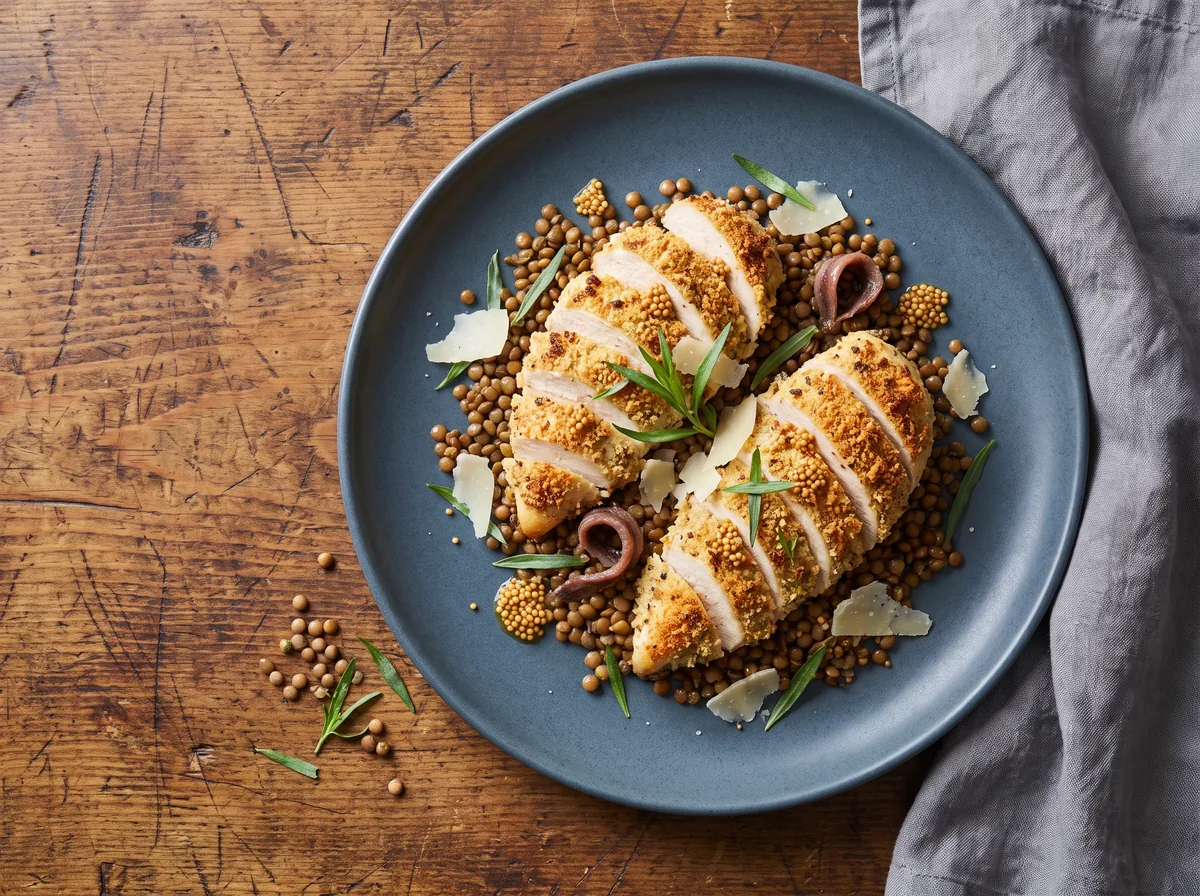
A muscle-building recipe as a complete meal: chicken breast in a crust of parmesan, wheat germ and tarragon on warm lentils. Fresh figs and a lime yoghurt make the plate juicy and sweet and sour. Around 77 g of protein per serving, overall Top 250 for the goal Muscles.
Open the recipe straight in the Food Secrets app. The app reads the ingredients, links each one to the nutrient database and recalculates the rank for your goal.
Ingredients for 2 servings
- Chicken breasts2 (300 g)
- Lentils, dried100 g
- Wheat germ40 g
- Parmesan, finely grated40 g
- Anchovy fillets4 (15 g)
- Egg yolk1
- Mustard seed, ground1 tsp
- Tarragon, dried1 tsp
- Figs, fresh4 (150 g)
- Plain yoghurt (bifidus)150 g
- Lime1
- Olive oil1 tbsp
Plus pepper. You hardly need salt – anchovies and parmesan bring enough. Beluga or brown lentils keep their shape when cooked. Out of fig season: 40 g dried figs, finely chopped into the warm lentils.
Method
- Cook the lentils in plenty of unsalted water for 20 to 25 minutes until soft, drain, only then salt lightly and keep warm. In salted water, lentils stay hard.
- Preheat the oven to 220 °C (top and bottom heat). Set a wire rack on a baking tray lined with baking paper. No glass or baking dish: juices collect in it and the crust goes soft from below.
- Flatten the chicken breasts at their thickest point until they are about 2 cm thick all over, and pat them very dry. That way the meat is cooked when the crust is brown.
- Finely chop the anchovies and stir them with the egg yolk and ground mustard seeds into a paste. Mix the wheat germ, parmesan, tarragon and 1 tsp of the olive oil with your fingers until the crumbs are slightly moist.
- Brush only the top of the chicken thinly with the paste, press that side into the crumbs and press the crust on firmly by hand. Chill for 10 minutes so that the crust sets and holds while baking.
- Place crust side up on the rack and bake for 18 to 20 minutes, until the crust is golden brown and the meat is no longer pink in the middle (core temperature 74 °C). If the crust stays pale, switch on the grill for the last 2 minutes.
- Meanwhile, stir the yoghurt with the juice of half a lime, a little grated zest and a pinch of salt until smooth. Quarter the figs.
- Let the chicken rest for 5 minutes and slice it crosswise with a serrated knife, so the crust does not break. Serve on the lentils with the figs and lime yoghurt, drizzle with the rest of the olive oil and lime juice and season with pepper.
Why this plate works for your muscles
Every ingredient carries its band from the Food Secrets muscle ranking. A band is stable – a place number changes with every data release, and the app shows you the exact figure.
- Top 10Egg yolkA dense nutrient package: choline, vitamin B12, vitamin D and all essential amino acids.
- Top 10AnchoviesThey season and salt at once, and bring omega-3 and vitamin D with them. Four fillets are enough.
- Top 50ParmesanLong-aged: lots of protein and calcium, lots of flavour, hardly any lactose.
- Top 250Chicken breastThe lean bulk protein. On its own no top score – in the mix it carries the satiety.
- Top 500TarragonDried herbs are mineral concentrates. Tarragon delivers potassium and manganese.
- Top 500Mustard seedSelenium and magnesium – both are involved in muscle contraction.
- Top 500Wheat germThe germ of the wheat grain: protein, vitamin E and B6, everything that white flour lacks.
- Top 500YoghurtSome protein and calcium – and it makes the plate juicy.
- Top 500LentilsThe slow carbohydrates and the fibre of the meal.
Averaged across all ingredients, the plate lands in the Top 250 for the goal Muscles. Figs, lime and olive oil carry no band: for this goal they sit in the neutral middle. They do not lift the rank, they make the plate juicy and rounded. One serving brings around 77 g of protein at around 730 kcal.
How to get a crisp crust
- Rack, not dish. In a glass or baking dish the chicken sits in its own juices. On a rack the hot air circulates and nothing softens the crust.
- Dry and flat. Well-dried meat holds the paste. Meat of even thickness is cooked before the crust burns.
- Crust on top only. A crust on the underside sits in the juices and comes away.
- Chill briefly. Ten minutes in the fridge let the egg yolk and parmesan set – then less breaks off when baking and slicing.
- A little oil in the crumbs. One teaspoon is enough for the wheat germ and parmesan to brown instead of drying out.
Variations
- In winter: 40 g dried figs instead of fresh, finely chopped into the lentils.
- Without anchovies: Make the paste from egg yolk and mustard only and add a pinch of salt.
- Vegetarian: Replace the chicken with 300 g firm tofu, pat it well dry, coat and bake the same way.
- Gluten-free: Replace the wheat germ with 40 g finely ground sunflower seeds.

Ingredients onto the shopping list, recipe into the week plan – in one step.
Frequently asked questions about this recipe
Why does my crust not get crisp?
Usually it is the dish: in a glass or baking dish, juices collect and the crust softens from below. On a rack, with well-dried meat, a crust on top only and 10 minutes of chilling before baking, it gets crisp and holds. More recipes the app sorts by goal are under All healthy recipes.
Which foods do the most for muscle growth?
In the Food Secrets muscle ranking, liver, egg yolk and oily fish such as anchovy, sardine and trout lead. Chicken breast is in the Top 250 – solid, but not at the top. That is why this recipe combines the chicken with egg yolk and anchovies. The full list is on the page Muscle-building nutrition.
How much protein does one serving have?
Around 77 g per serving at around 730 kcal, from chicken, lentils, parmesan, wheat germ, egg yolk and yoghurt. Plus around 19 g of fibre. After the import, the app works out the exact figure for your amounts.
Can I prepare the crust in advance?
Yes. The dry mix of wheat germ, parmesan and tarragon keeps for a week in a closed jar. Make the anchovy paste fresh, because it contains raw egg yolk. With the Food Secrets app you can put the recipe straight into your week plan.
How much protein do you need to build muscle?
The usual recommendation is 1.4 to 2.0 g of protein per kilogram of body weight per day, spread over several meals. One serving of this plate covers about half of that for a person weighing 75 kg. What matters is the total over the day. The foods that bring the most are on the page Muscle-building nutrition.
What does “Top 250” mean at Food Secrets?
The app rates more than 1000 foods and gives each a rank per goal. “Top 250” means: averaged across all ingredients, this recipe sits among the best 250 for the goal Muscles. We print bands rather than place numbers, because the database keeps growing. The app works out the current value after the import.
More healthy recipes and food rankings
- Nutrition for muscle building: app and food list – the groundwork and the full ranking of foods for muscle growth.
- Recipe generator: import and analyse healthy recipes – read in any recipe from the web, calculate the nutrients and build the shopping list automatically.
- All healthy recipes by goal – recipes for muscles, inflammation, heart, immune system, blood sugar and other health goals.
- Active compounds in food – what is behind the ranks, and the studies for them.
The bands on this page are a snapshot of the Food Secrets ranking. The database keeps growing, which is why we name ranges rather than place numbers – the app works out the current value at any time. The information provided is for general education and does not replace medical advice or treatment.